
Free Private Cities
Free Private Cities are characterized by a distinctive system of governance. In these cities, a private company (a City Operator) is responsible for the city’s administration and the provision of security and the rule of law. All other services are provided by private third parties and/or residents themselves.
A central feature of this system is the Citizen Contract, in which the rights and obligations of both the resident and the City Operator are explicitly laid out. Besides the rules of living together specified in the Contract, the Operator has no right to further intervene in any areas of the resident’s life without their consent. Disputes over the contents of the Contract or the conduct of one of the parties are adjudicated by a third-party arbitration court that is fully independent from the Operator.
Free Private Cities can be established either as autonomous zones within Host Countries or as fully independent entities. Whatever the setting, it always involves a legal agreement with the Host Country that forms the legal underpinning of the city’s status. The Free Private City is one of the modern Free City models that exemplify the creative renaissance of Free Cities in today’s age.
Also covers: FPC · Free Private City · Private City · Private Cities · Citizen Contract · City Operator · Freie Privatstadt · Freie Privatstädte · Privatstädte
One of the models under the Free Cities umbrella.
Updated
Articles
Blog21 min read
Johannes Kaiser Interview: Free Cities in Libertarian Chile
Can you fight the state by becoming the state? It is the one question every political libertarian has to answer, and Johannes Kaiser has heard it more often than most. Last November, the leader of Chile’s National Libertarian Party won 14 percent of the vote in the country’s presidential election, one of the strongest results a libertarian party has ever achieved anywhere in a national first round. A few months later, we found ourselves sitting across from him at a lakeside campground in eastern Germany, asking him exactly that question.
 Jan Bertram · Free Cities Foundation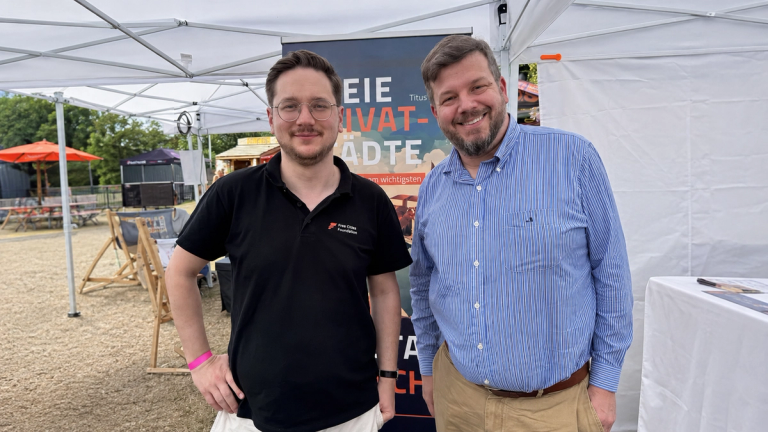
Blog11 min read
La Façon de Vivre
Geoffrey has loved something about every great city he has lived in, but never everything. Then a typed note in a dusty bookshop, franked with five blue stamps, invites him to a place called Possibilia.
 Sebastian A. S. Grell
Blog7 min read
Why Private Cities Are Good for the Planet
Cozy neighbourhoods shaded by eucalyptus trees and protected wildlands stretching from the Santa Ana Mountains to the Pacific Ocean—welcome to Irvine, a master-planned city in Orange County, California. With its Mediterranean climate, thriving economy, and more than one-third of its land reserved for green open space, Irvine consistently ranks among the happiest (top 3), healthiest (top 10), safest (top 3), and greenest (top 10) cities in the United States.
 Vera Kichanova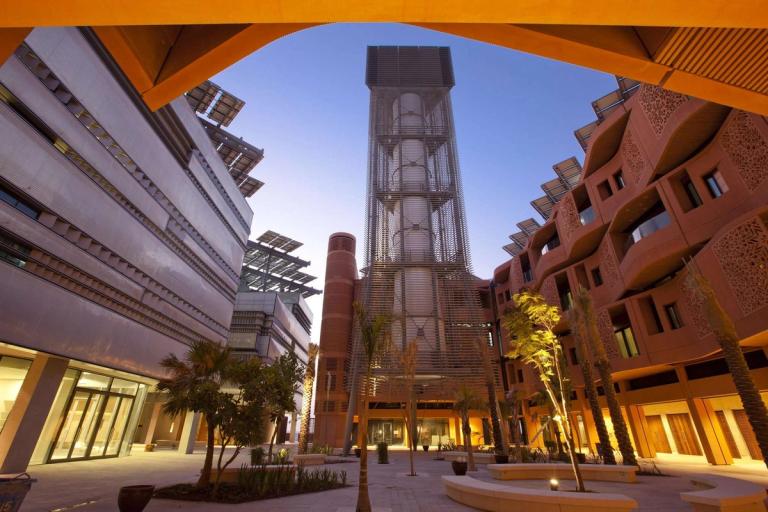
Blog14 min read
Surprise! The “End of History” Is Not the End of History – Why We Need Free Private Cities
Speech by Dr. Titus Gebel on the occasion of receiving the Roland Baader Award 14 June 2025.
 Titus Gebel · Free Cities Foundation
Blog4 min read
The Proprietary State – Available Now on Amazon
What if a government takes the form of a for-profit corporation? Forget the usual debates about left versus right. The Proprietary State throws a curveball into the entire political landscape. It dares to ask: what if we privatised the very act of ruling? Imagine a government with shareholders instead of voters, pursuing profit. The book dives deep into this radical idea, dissecting the potential boons and pitfalls of a ‘proprietary government’ – a government driven by profit motives, accountable to investors instead of voters.
 Free Cities Foundation Team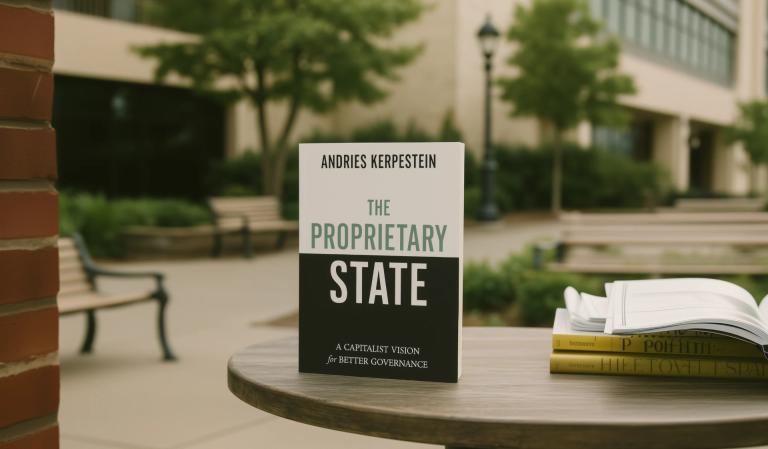
Academic31 min read
Free Private Cities: A Market-Oriented Solution to the Problems of Government Intervention
Free Private Cities (FPCs) are a new model of governance in which a purely private, investor-owned company provides the services of a State in a city-sized area. Free Private Cities attempt to provide Governance-as-a-Service (GAAS) by treating the relationship with residents as that between a service provider and a consumer rather than ruler and subject. The key characteristics of FPCs include a contract signed between the consumer and the FSP Operator, consensual taxes and/or fees charged by the Operator to the resident consumer, and the provision of infrastructure including energy, water treatment, roads, security, dispute resolution, and others. This paper first lays out in detail the risks, pitfalls, and negative consequences of government intervention in the economy and then examines the FPC model of governance to determine if it is distinctive enough to avoid the same pitfalls or if it merely represents a form of privatized statehood that suffers from many or most of the flaws of traditional governments.
 Alex Voss · Free Cities Foundation
Blog11 min read
Constitution of Consent
The Constitution of Consent Contest was held in mid-2023 and organized by Max Borders. Intended to jumpstart and accelerate a conversation around the best forms that emerging models of consensual governance could take, the task was to:
Alex Voss · Free Cities Foundation
News4 min read
Strategies for Liberty: Free Cities & Bitcoin by Alexander D. Voss – Out Now!
The Free Cities Foundation is proud be publishing Alexander D. Voss’ new book Strategies for Liberty: Free Cities & Bitcoin. Though both of these topics – Free Cities and Bitcoin – have been extensively covered on their own, this book is the first systematic exploration of the interplay between the two. It lays out how important synergies between Free Cities and Bitcoin can make it easier for us to achieve a freer future.
Free Cities Foundation Team















Videos
Free Cities Foundation
Free Cities Conference 2026
Doha Debates
Free Cities Foundation
Free Cities Online Summit 2025
Liberty in Our Lifetime 2024






Podcast episodes
Podcast Episode 181
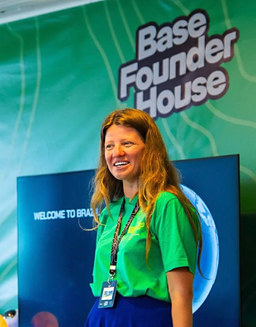
Paloma Lecheta: Brazil’s First Free City
Paloma Lecheta on Jurerê Internacional, the Brazilian neighbourhood privately run since 1980, and the push to make it Brazil's first Free City.
Podcast Episode 157
Vera Kichanova: Climbing a Ladder of Consent
Vera Kichanova on the post-COVID surge of interest in Free Cities, the role of consent, and answering critiques that they serve only the wealthy.

Podcast Episode 114
Alex Voss: Strategies for Liberty, Free Cities & Bitcoin
Tipolis CFO Alex Voss on the intersection of Bitcoin and Free Cities, regulatory autonomy and negotiating with host governments.

Podcast Episode 71
Vera Kichanova: Private Cities, Russian Politics & The Middle East
Economist Vera Kichanova, holder of the first PhD on private cities, on building cities in the Middle East and her start in Russian politics.

Podcast Episode 50
Titus Gebel: Free Private Cities Book Update
Titus Gebel on the new edition of his book Free Private Cities, what's changed since 2018, and Free City culture, design and ethics.

Podcast Episode 34
Titus Gebel: Breaking the Political Cycle
FCF founder Titus Gebel on breaking the political cycle, the history of city-state models and his vision of government as a service.

Podcast Episode 1
Peter Young: Free Cities Overview
FCF Managing Director Peter Young gives an overview of the Free Cities Foundation, governance choice, contracts and parallel finance.

In the media
Financial Times
Tech elites are starting their own for-profit cities
Pacific Research Institute
Creating 'Free Cities' as Plan B for global societies
The Bitcoin Reserve Show
Free Private Cities & Bitcoin with Peter Young
Stephan Livera Podcast
Bitcoin Adoption in El Salvador, Free Private Cities and the Honduran ZEDEs
Adopting Bitcoin Conference
Veronika Kuett & Peter Young talk about Bitcoin and Free Private Cities at the Adopting Bitcoin Conference
Peter Young talks to John Vallis about Bitcoin Citadels and Free Private Cities
Kite
Free Private Cities – Why Governments Are Obsolete Relics
Bitcoin Urbanism
Satoshi's Sidewalk #25: Free Private Cities
Tales from the Crypt
Free private cities, economic zones, and gradual progress with Rahim Taghizadegan
What a Free Private City of the (not so distant) Future Will Look Like
 Deutsch
 Русский
 Español
 Français
 Italiano
 Português
Books

What Would Life Be Like in a Free Private City?
Innovative service providers such as Uber or Airbnb would be welcomed to a Free Private City. Private entrepreneurs would provide everything demanded by citizens: from hospitals, schools and kindergartens to waste collection and transport. If desired, residents would take out private insurance or set up self-help groups to protect themselves against illness, death, need of care or accidents. Anyone would be free to offer new products and services without authorization or license, and get paid in any currency they desire, including bitcoin. Lack of labor market restrictions such as minimum wage laws would mean that lower skilled workers would easily find jobs, rather than being excluded from the labor market. New drugs and treatment methods would be available to any adult wanting to test them with knowledge of the potential risks. Environmental thresholds would apply only to products and processes deemed truly dangerous by serious scientific research. Crime and vandalism would hardly exist. Citizens would be able to let their children out on the streets at night without having to worry.
In Free Private Cities, people would not be stirred up against each other by politics. In a contract-based society with no parliament or central bank, political activism would no longer play a significant role in people’s lives. Without the fetters of top-down regulation, residents would be able to produce innovations that improve productivity. Free Trade would prevail, and everyone would be able to import everything duty-free. No taxes would be payable apart from the annual contribution to the operator specified in the Citizen Contract. Through this system, even low-income earners would be able to achieve a high standard of living.
Because neither currency nor interest rates would be manipulated by governments and central banks, the purchasing power of the residents of Free Private Cities would constantly increase. Pension schemes would be private and allow for retirement whenever the person concerned considers their funds to be sufficient.
Political activism, missionary zeal, distributional struggles and the stirring-up of social groups against one another would practically disappear in Free Private Cities. Residents would know that they cannot interfere with the contracts of fellow citizens and would respect each other’s different views and assessments. People would once again be responsible for taking care of themselves. This would make them more self-confident, stable and realistic in their assessments. After a couple of generations, Free Private Cities would be wealthier, freer and more peaceful than any place we have known so far.
Once the first Free Private Cities have been successfully established, a completely new, highly lucrative asset class will emerge. This is because both the “software” (the legal and contractual framework), and the “hardware” (the master plan and infrastructure), can be reused as often as required and adapted for different purposes.
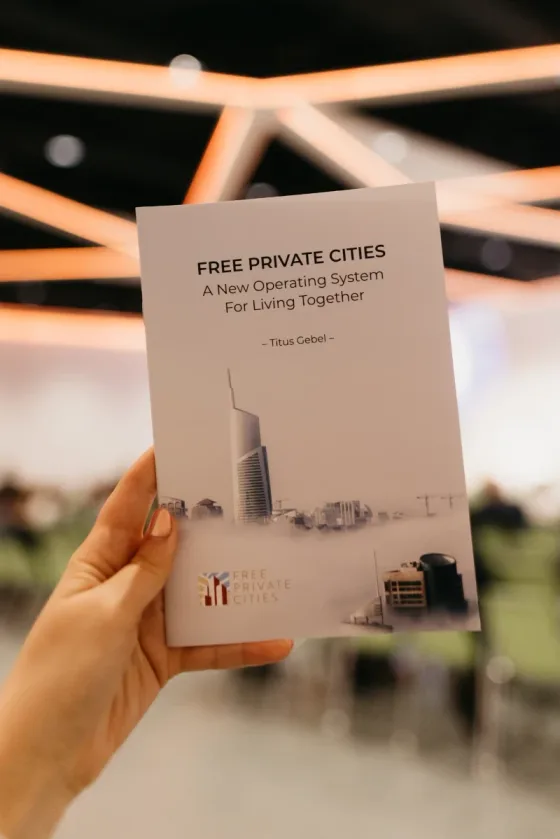
Free Private Cities: A New Operating System for Living Together
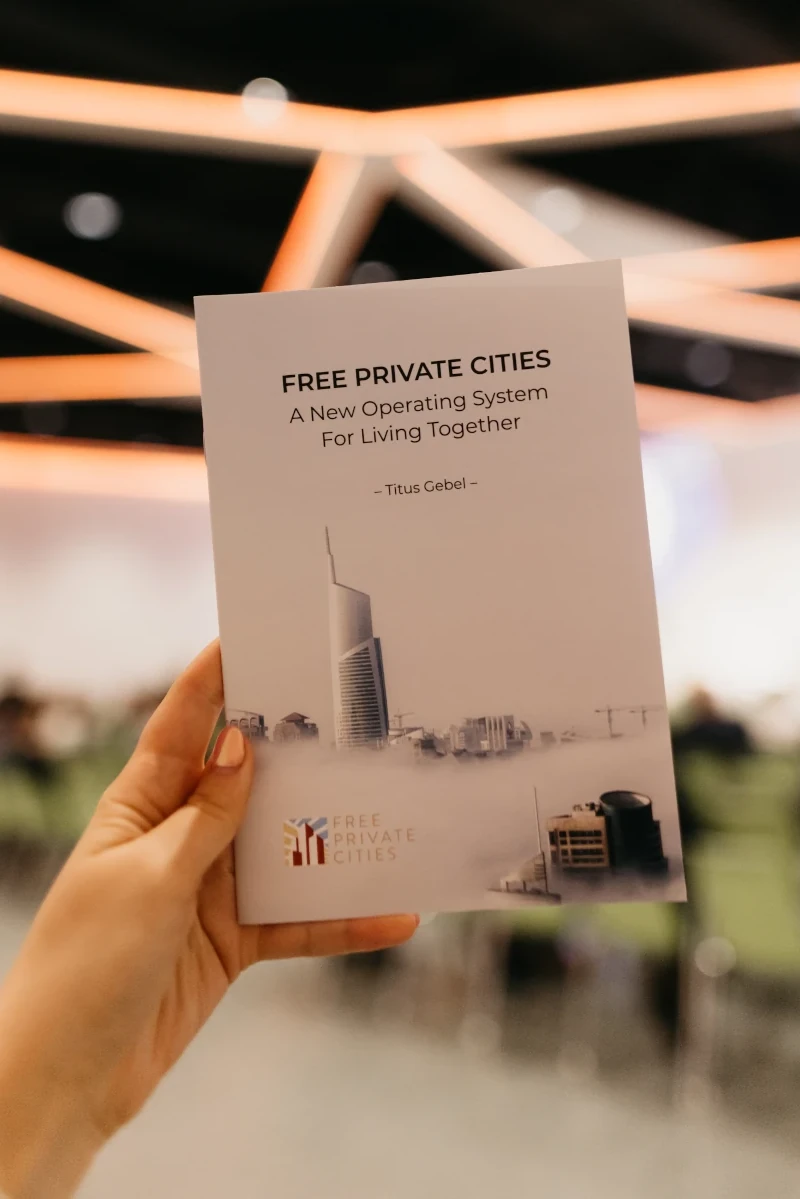 AuthorTitus GebelFree Cities Foundation
Version 2.0, January 2023
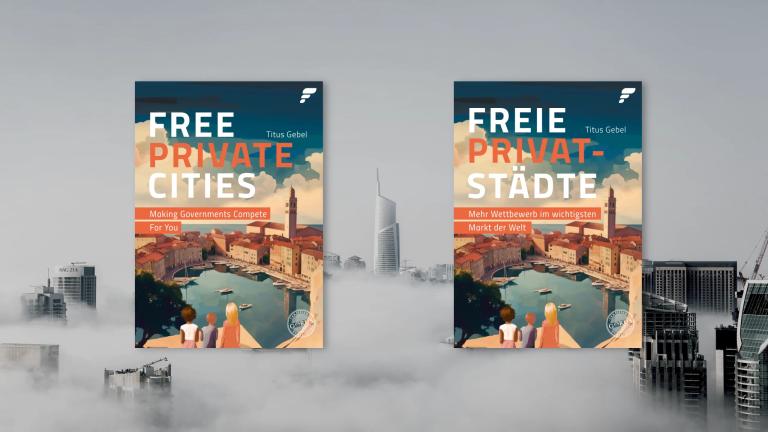
Free Private Cities is the concept of Dr. Titus Gebel, an entrepreneur with a doctorate in law. He co-founded the energy and resources group Deutsche Rohstoff AG and stepped down as its CEO in 2014 to work on the idea full time. He set it out in the book Free Private Cities: Making Governments Compete for You, first published in 2018 and now in its third edition, and in the whitepaper on this page. He founded the Free Cities Foundation to give the idea a non-profit home and leads Tipolis, a company that develops new jurisdictions together with governments and special economic zones.
In current political systems, the actions of both rulers and the governed are shaped by wrong incentives. Rulers have no liability and face no economic disadvantage if they make poor decisions. The governed are made to believe that “free” benefits can come into existence through the power of their votes. This politicizes the state monopoly on force and leads to constant changes to the “social contract” and an endless struggle to influence the direction of this change.
In this paper, I propose a peaceful and voluntary alternative to the political status quo: Free Private Cities. The defining feature of a Free Private City is that it is run by a for-profit company, referred to as the Operator, which acts as a “government service provider”. This company can also be organized as a cooperative or be wholly owned by the citizens. In this capacity, the Operator offers citizens of the Free Private City protection of life, liberty and property. These services encompass internal and external security, a predefined legal and regulatory framework and an independent dispute resolution system. Interested individuals and companies enter into a Citizens’ Contract, paying a fixed yearly fee for these services instead of taxes. Within that framework, a “spontaneous order” can develop which emerges from the voluntary activities of the citizens. The Operator cannot later unilaterally change the Citizens’ Contract without the permission of the citizen concerned. Disputes between citizens and the Operator are heard before external arbitration tribunals, as is already customary in international commercial law. If the Operator ignores arbitral awards or abuses its power, customers will eventually leave and the Operator will face the risk of bankruptcy.
Since all land is currently controlled by governments, the establishment of a Free Private City requires that an Operator enters into a contractual agreement with an existing state, referred to as the Host Nation. In this agreement, the Host Nation grants the Operator the right to establish the Free Private City on a defined territory in accordance with certain predefined conditions, normally encompassing extended regulatory autonomy in various fields. One would expect states to be willing to surrender some of their power if they expect large enough benefits in return. Such benefits could include job creation, attraction of foreign investment and a percentage of profits generated by the Operator. The existence of a large number of Special Economic Zones worldwide demonstrates the willingness of states to do this.
1. THE UNSOLVABLE PROBLEM OF CURRENT SYSTEMS
1.1 Overstretching Leviathan
In his famous book “Leviathan”, Thomas Hobbes argued that a state monopoly on force creates a peaceful order that ultimately benefits all of the state’s inhabitants. It is indeed the case that innovation, division of labour, trade, scientific progress and flourishing of the arts cannot be achieved in an environment plagued by violence. However, a substantial part of this advantage is lost if the state uses its monopoly on force to achieve goals that go beyond the enforcement and protection of peace.
That is when the state becomes politicized and imposes political goals on everyone, which tend to be outcomes only desired by certain interest groups within society. In the end, politics inevitably implies imposing one’s view of the world on all others. But people are different. What is right for one person is often wrong for another. The fact that individual values are ultimately subjective and that people also have objectively different life situations causes any “political solution” to leave behind those who have been forced to do something against their will. To “make politics” means taking sides and making the wishes of some the yardstick for all. Finally, by force, since these political solutions are ultimately backed up by the threat of violence through the executive branch of the government.
In current political systems, the relationship between citizens and governments is analogous to the relationship between somebody who wants to buy a car — while the car dealer (the government) insists that he will choose the model, the colour, the size of the motor, the interior, as well as the price the buyer (the citizen) has to pay for it. And furthermore, there is no choice in the deal: everyone must buy. This is an obviously unattractive deal, yet this is the deal most of us accept through our political systems.
The alleged “social contract” is constantly being changed, but only by one side: the state. However, if the state monopoly on force becomes an instrument of politically motivated partiality, then the original concept loses its effect. Behind the façade of the peaceful state, a perpetual struggle of rival groups arises. Politics thus becomes an invisible civil war, whose discreteness stems from the fact that the victims of state interference have no realistic chance of defending themselves. The peace achieved in modern states is illusory and based on the effective suppression of divergent interests.
It is therefore counterproductive to give the state a power that goes beyond guaranteeing internal and external security. Because once peace is established, the only legitimate governmental task should be to ensure that residents do not force their will upon others. The state itself may only use force to safeguard this principle.
1.2 When the Minimum Principle meets Politics
There is a problem: In practice, this kind of self-restraint on the part of the state is impossible to achieve. Human beings tend to prefer the social order that offers them the highest “return on life” at the lowest price, meaning they attempt to obtain as much benefit as possible for as little effort as possible. This natural human disposition, which is referred to as the minimum principle, makes sense from an evolutionary perspective. It has led to innovation, specialization and division of labor, which allow the average person in most countries to live in a state of affluence that was previously only accessible to the privileged upper classes.
In order to achieve their ends, humans interact with others. As long as these interactions are voluntary, both parties seek to benefit from them – otherwise, these interactions would not take place. Voluntary interaction is always initiated by a promise: “I will give you something valuable in return”. However, whenever somebody wants another person to interact with them, they face an alternative, namely, to issue a threat: “If you don’t comply, I will harm you”. As soon as somebody tries to achieve their ends in this manner, the other party will most likely be damaged, and the social order will be weakened.
In theory, all the members of the social order could agree to jointly suppress violent behavior. However, the benefits derived from the division of labor, economies of scale and economies of scope, suggest it may be prudent to agree on a “guarantor of the peace” who is solely allowed to enforce this agreement, if so required. In our current world this guarantor is the state.
Now, if the human disposition towards the minimum principle meets with state power, a problem arises: due to the state’s monopoly on the use of force politics can promise benefits, such as subsidies and handouts, that seem to cost the recipients nothing. In reality they are on the expense of other citizens. This turns the original idea of preventing harmful interaction upside down: Now, the most powerful institution itself initiates harm. The human disposition toward the minimum principle will lead to interest groups seeking to maximize their own benefits at the expense of others with the help of the state. From the recipients’ point of view, subsidies and handouts are an appealing concept: they put in no effort, yet receive profit. Essentially, the granting of child benefits, free health care or an unconditional basic income, can be classified as the buying of votes. Such subsidies lead to a population demanding ever more short-term benefits, unconditional promises and additional “free” offers.
The dynamics described here also ensure that the state interferes more and more in citizens’ private lives. This is because “intangible benefits” are also distributed, like regulations in favour of the wishes of certain interest groups. Since almost every interest group tries to take their personal wishes into account, the number of laws, the tax burden and the national debt inevitably increase over time. Political polarization is an unavoidable outcome of such a system. The possibility of individuals leading their lives according to their own tastes, becomes increasingly restricted.
In theory, this problem can be overcome using reason and persuasion while in practice, the minimum principle remains stronger. Politicians or rulers who advocate cuts in benefits will sooner or later be voted out of office or replaced by more “supportive” and “generous” mandate holders. Over and above that, the respective rulers have no incentive to behave sustainably, since they bear no economic consequences for their decisions. They remain legally immune from liability and have no enforceable obligations towards those whom they rule.
However, such systems cannot continue to function in the long term. Inevitably, overpromising and subsidizing unprofitable but well-meaning programs will lead to governments running out of funds, bringing about self-destruction of the prevailing political system. Fiscal trickery by central banks, such as downward manipulation of interest rates or the purchase of their own government bonds, can only delay this result, not prevent it.
I am well aware that the following is an extremely painful realization for many, but there is no way around this insight: A system, however legitimated, which by law provides for expropriations in favor of third parties (for example in the form of taxes and social security contributions) and to which not all those affected have agreed to, cannot lead to a system of peaceful and stable cooperation. The foundations and results of voluntary cooperation are destroyed through the exertion of state power. True solidarity cannot emerge in an environment of coercion. The resulting battle of all against all for the implementation of regulation, favorable to some at the expense of others, successively undermines what makes a society cohesive, successful and attractive.
2. CRITERIA FOR ALTERNATIVE SYSTEMS
It is no use blaming people for following their evolutionary dispositions or complaining about politicians for delivering what the electorate wants. The only remedy is to decentralize and limit power. The fewer areas of life politics controls, the less important it is who controls or influences politicians. Anyone who wants to avoid receiving special benefits from the government at the expense of third parties must create a system of government that cannot grant special benefits at all.
Hence, we have to define a system that by design avoids misaligned incentives and is inherently stable. A new, long-term, stable social order must require those in charge to:
- be unable to grant special benefits to individual groups or citizens (avoidance of lobbying, corruption and struggles over state largess),
- be held liable for errors (coupling of power and responsibility),
- have an economic interest in the success of the society (skin in the game),
- allow their citizens to leave or secede at any time without imposing financial or other obstacles (enabling competition),
- have clearly defined written obligations, changeable only with the consent of both the governed and the rulers (a real social contract, legal certainty, predictability),
- be suable by the parties concerned in the event of differences before independent courts or arbitration bodies (neutral dispute resolution).
At present, even Western democracies only fulfil the last of the above criteria, often with caveats, since only certain organs can sue the government and the courts are financed by the same government. The legal security and predictability provided by constitutions is no longer effective in practice, since those in power, with their parliamentary majorities and by the appointment of judges, can largely control both the wording and interpretation of the constitution.
3. GOVERNMENT AS A SERVICE: FREE PRIVATE CITIES
This paper proposes a concept that fulfils the above criteria and overcomes the problems described above. The concept is called a Free Private City.
3.1 Defining Elements of Free Private Cities
- A Free Private City is a sovereign or semi-autonomous territory with its own legal and regulatory framework. It has its own tax, customs and social regime, as well as its own administration, security forces and an independent dispute resolution system (autonomous regulation and administration).
- Free Private Cities are run by an operating company as a for-profit business (“Operator”). This company may be a private or publicly listed entity, organized as a cooperative and can be also wholly or partly owned by the citizens. The Operator guarantees inhabitants of the Free Private City protection of life, liberty and property which it provides in exchange for a fixed basic fee (Protection by Operator).
- Each individual resident or residing entity has concluded a written “Citizens’ Contract” with the Operator, which clearly defines their mutual rights and obligations. This includes the services to be provided by the Operator and the fees to be paid to them for their services; there are no taxes. It also outlines rules that apply in the Free Private City: both for the citizens and the Operator. A defining aspect of the Citizens’ Contract is that it cannot be unilaterally changed by either party. It represents the “personal constitution” of every contract citizen (real and reliable social contract).
- Participation and residence in the Free Private City is voluntary (voluntary participation).
- There is no legal claim to admission to the Free Private City; to fulfil the security promise, the Operator decides on immigration according to his criteria and his discretion (immigration policy).
- Furthermore, contract citizens can do as they please, provided that they do not violate the rights of others or the rules laid down in the Citizens’ Contract (the live and let live principle).
- Any citizen can terminate the contract at any time and leave the Free Private City, but the Operator can only terminate the contract for good cause, for example for breach of contractual obligations such as continued non-payment of the fee (unilateral free contract cancellation).
- Coercion by the city operator can only be used to enforce the predefined and agreed rules. Serious or repeated violations lead to exclusion from the Free Private City (contract-violation-based exclusion possible).
- In the event of conflicts with the Operator, each party is entitled to appeal to independent (arbitration) courts that are not part of the Operator’s organization (independent arbitration).
3.2 Real Social Contract
In a Free Private City, everyone would be the Sovereign of Themselves. By voluntary agreement, they have concluded a genuine contract with a more or less ordinary service provider. Both parties have the same formal rights and are therefore legally on an equal footing. In Free Private Cities, the relationship between ruler and subject in traditional governance systems is replaced by a relationship between customer and service provider. For the first time in history, there would be a real “social contract” with predefined rules, not a fictional one that is repeatedly changed by one side.
Unlike conventional systems, where the citizen is obliged to pay tax without having a corresponding right to benefits, in a Free Private City service and compensation are directly related. Both contracting parties are entitled to fulfilment of the contract by the respective counterparty. The Operator can demand payment of the fixed contribution from the citizen, but no additional fees (unless the citizen agrees). In turn, the citizen can sue the Operator for non-compliance with his contractual obligations such as ensuring security and a functioning system of private law. Who actually manages or to whom the operating company belongs is of no relevance to the functioning of the model. As said, the Operator could even be owned by the citizenship as a whole.
At the same time, the strictly bilateral contract between citizens and the Operator addresses an age-old problem of mankind: the desire of some people to impose their will on others. In a Free Private City, there is no platform for paternalists and rent-seekers to hijack. Political activism, missionary zeal, distributional struggles and the stirring-up of social groups against one other would disappear, because of the simple lack of a benefit for the executing party. Citizens know that they cannot interfere with the Citizens’ Contract of fellow citizens and would subsequently learn to respect each other’s differing views and assessments.
The Operator is neither king nor dictator, but a mere service provider who may (or must) only do what both sides have agreed in the contract.
Disputes between the Operator and citizens will be heard before independent arbitration tribunals, as is already customary in international commercial law. If the Operator ignores the arbitral awards or abuses his power in any other way, his customers will leave and he will eventually face bankruptcy. The Operator therefore faces a real economic risk and therefore has every incentive to treat his customers well and in accordance with the Citizens’ Contract.
Since the Operator has limited responsibilities, namely the protection of life, liberty and property of the citizens, he would only guarantee the framework within which society could develop as a “spontaneous order”. A spontaneous order is an order which emerges as the result of the voluntary activities of individuals, based on their decentralized knowledge, rather than as a result of government mandate or central planning. Examples of systems which evolved through spontaneous order or self-organization include the evolution of life on Earth, languages, the Internet and free market economies.
3.3 Main Principles
There are just a few simple principles that determine how people live together in a Free Private City. The guiding principle is self-determination and private autonomy, the right to shape one’s legal relationships according to one’s own decisions. Furthermore, the Golden Rule applies as expressed in the proverb “do not unto others what you do not want done unto you”. In addition, the principle do ut des (I give so that you give) is valid, the recognition that merit is based on reciprocation. Finally, there is the principle of voluntaryism and non-aggression, meaning interactions are based only on voluntary cooperation, rather than coercion and expropriation, including for allegedly “good” causes. The result is a “live and let live” society.
3.4 Profit Motive
The Operator’s profit motive is of central importance to the Free Private Cities model. Many people consider the pursuit of profit to be something immoral, especially when it touches on social issues like our living together. They fail to recognize that there is no better incentive than the profit motive to make optimal use of scarce resources. Competition with other systems and the need to make profit incentivizes the Operator of a Free Private City to permanently seek to improve his “product” and optimize the use of scarce resources. This ultimately results in elevated satisfaction and better-quality services for citizens.
Every decision the Operator makes has an immediate impact. The Operator must ask whether his actions will increase the satisfaction of the citizens or whether it is better to implement cost-cutting measures that allow fees to fall so that the Free Private City can become more competitive. In other words, before the Operator acts, he must first ask whether his action will ultimately generate more revenues than expenses. If more revenue is generated, profit is made and the enterprise value of the Free Private City is increased, reflecting the increased contentment of the individual residents and residing entities. If the measure will be loss making, the measure should either be improved or reversed. Such efficiency, and therefore elevated quality of life for all stakeholders, will never be achieved by public state systems.
3.5 Competition
Free Private Cities can be modified in all directions, from anarcho-capitalist models without a monopoly on force to kibbutz-like communes without private property. The choice of different concepts makes it possible to defuse most political conflicts and replace them with a peaceful coexistence of different systems that everyone voluntarily enters into. Precisely because people’s preferences differ and we cannot know which system is evolutionarily the best for whom, we must allow for diversity and competition to flourish. A single world government would be an extreme danger to liberty: No more exiles, no more comparison, no more choice.
The view of a social order as a “product” on the “Market of Living Together” and the peaceful competition of systems for citizens as “customers” will considerably increase both peace and liberty. This is because finding solutions on the market is non-violent, non-revolutionary, but instead an evolutionary process that takes place through mutation (trial and error), selection (profitability or bankruptcy) and reproduction (imitation of successful solutions).
Therefore, alternative forms of society must firstly be allowed and secondly, citizens must not be prevented from exiting the system. Anyone who does not want to be a Sovereign of Themselves but prefers a communitarian atmosphere and “social warmth” has every right in the world to seek that out. But he or she has no right to detain or restrain against their will those who prefer freedom or to force them to finance his or her desired way of life. Social orders that only work if people are held in them against their will and forced to behave in a certain way will fail in the long run anyway. If you have a good product, you do not have to fear criticism or competition and therefore do not need to prohibit or regulate them. In fact, competition has proved to be the only permanently effective means of limiting human power.
3.6 Implementation
Penetrating the Market of Living Together is not easy. Normally one has to win an election, carry out a revolution or organise a movement for secession.
The establishment of Free Private Cities is a peaceful alternative to these methods. Undoubtedly, getting existing states to give up part of their sovereignty is an ambitious task. Nevertheless, this path seems easier than changing existing systems “from within” to make them more amenable to freedom, legal security and self-responsibility. The fact that all over the world many Special Economic Zones already exist, some with a “one country, two systems” model - shows that similar paths are possible. In a way, the Free Private Cities concept is merely the next stage in the evolution of Special Economic Zones. Describing it in this way may make it easier to convince potential host countries.
The establishment of a Free Private City requires a contractual agreement with an existing state. In this agreement, the “Host Nation” grants the operating company the right to establish the Free Private City on a defined territory in accordance with the agreed conditions. To ensure voluntary participation, it is best for the area proposed for the establishment of a Free Private City to be initially uninhabited. The degree of autonomy the respective Free Private City will actually end up having, is a matter for negotiation with the Host Nation. It is unlikely that a Free Private City will be able to negotiate complete independence. In addition to territorial sovereignty (defence, foreign policy), the Host Nation will probably insist on the continued application of certain legal norms, such as the validity of the human rights enshrined in its constitution, as well as continued respect for its international agreements and criminal codes. The Free Private City should be able to cope with this without giving up its essence. In this respect, the Free Private City will not be able to grant its own citizenship; residents will keep their own, but they will get a residency status in the Host Nation.
States may agree to surrender some of their power over a certain territory if they expect to benefit from it. A win-win situation between the Operator and the Host Nation must therefore be created. The establishment of Free Private Cities in structurally weak areas not only increases their attractiveness to the surrounding region, but also stands to create jobs and investment in the neighbouring areas, which ultimately benefits the Host Nation. Hong Kong, Singapore and Monaco provide good examples: A cordon of densely populated and, comparatively prosperous areas has formed around these city states. Inhabitants of the Host Nation often work in the neighbouring city-state, but pay taxes in the motherland. If one assumes that such developments take place in a formerly structurally weak or completely uninhabited area, then the Host Nation only stands to benefit.
4. ADDITIONAL CONSIDERATIONS
The following are the most frequently raised issues when discussing the idea of Free Private Cities. Further details are covered in the links provided at the end of this document.
4.1 Target Group
Free Private Cities target all income groups as well as all businesses. The estimated costs for the mandatory basic package, consisting of infrastructure, security and the legal and dispute resolution system, will amount to approximately USD 1,500 per person per year (less than an ounce of gold). The amount may be adjusted downward in low-income countries. The fact that no taxes are levied relieves the financial burden on the residing entity considerably, especially on single entrants to the labour market, but also on all middle-income earners with families. The funds freed up are available for citizens’ own health and pension savings plans or membership of self-help institutions, as well as for their children’s education. Since they are tax-free and have a low-regulation, business-friendly, service-oriented legal regime, Free Private Cities offer considerable incentives to settlers, especially companies. As a result of their economic activity, jobs will also be created for low and middle-income earners.
4.2 Social Security
Free Private Cities will allow for the establishment of voluntary, multi-layer support networks for those with disability, illness or other incapacity. Collective self-help institutions, private insurance providers, as well as support by family and friends and charities would be encouraged (dealt with in detail in the book on Free Private Cities). These institutions should be sufficient to deal with all cases of real hardship in a community. Some Operators might choose to add a contractually guaranteed minimum social security.
4.3 Environment
Free Private Cities have an interest in maintaining a clean environment as a means of attracting residents. In principle, environmental protection in the Free Private City is based on the protection of individual rights. Environmental damage is unthinkable without affecting property, possessions, or persons. Therefore, there is a corresponding right to sue anyone who pollutes the environment of another, and it must then be decided by independent courts whether the claim is justified. In a Free Private City, there is no tragedy of the commons because all land and waters are owned, or at least controlled, by actors. This applies in particular to the Operator himself, who in addition to his administrative activities is also subject to private law as the owner of land, streets and squares. As such he can use his right to sue in cases of environmental damage to his property.
4.4 Democracy
The Operator acts as an actionable service provider with a narrow scope: protection of life, liberty and property according to pre-defined and pre-agreed rules, which are not unilaterally changeable. The vast majority of life decisions happens outside the Operator’s sphere of influence. If everyone can decide nearly everything for themselves, including how they want to live and which causes they want to support, then there is no need to delegate these decisions to a parliament, government or majority vote. Free Private Cities should enable maximum self-determination, not maximum co-determination. With the evolution of a governance system from one of majority rule to one of self-determination, there is no more principal-agent problem arising from the fact that agents might prefer their own interests over the interests of those they represent. If everyone can decide which products and projects continue to exist and which do not, there is more democracy in the sense of a rule of all than in a majoritarian system. Through this process, Free Private Cities are able to achieve “full-democracy” rather than the quasi-democracy represented by the majoritarian systems of today.
4.5 Monopoly on Force
Because of the territorial monopoly on force, the Operator would in theory be able to misuse this monopoly and behave like a dictator. However, most citizens would respond by leaving the Free Private City, and it would be impossible for the Operator to successfully found new cities elsewhere due to his loss of reputation. In this respect the Operator is no different from the captain of a cruise ship on the high seas or the head of a remote holiday resort. Both could theoretically take the opportunity to act as dictators, but refrain from doing so because of their commercial interests.
Allowing competing security service providers with their own rules and thus competing legal systems may appear theoretically attractive for reasons of preventing monopolies. In practice, however, the effort and inconvenience involved (transaction costs) are probably too high. It would take years for rules to develop in the market on how to resolve collisions between the various providers and legal systems. In practice, the owners of the strongest security service could do what they want.
Once the model of Free Private Cities has proven itself profitable, then competitors will inevitably appear on the scene. This is the best guarantee for the residents that the respective Operators will not abuse their position of power. Apart from that, the right of every contract citizen to self-defence and the corresponding support of third parties against attacks remain unaffected or expressly guaranteed by contract.
4.6 Contract Changes
Constitutions of nation states can be changed, even against the will of the people, provided a qualified (parliamentary) majority agrees to the change. Contracts, on the other hand, can only be changed if both contracting parties agree. That is why the Citizen Contract and the corresponding legal position are so important to the protection of the individual residents’ rights. However, even the best contract cannot foresee all possible future contingencies. But a contract that can be changed at any time by the Operator or contains vague language would be of no real use to the citizens. Therefore, the wording of the contract must be as clear and unambiguous as possible. If later this leads to disputes of interpretation due to missing or vaguely formulated clauses in certain areas, then the respective (arbitration) courts will decide the controversial issue and fill the legal gap, using the pre-agreed legal principles that have been in force for centuries and a reasonable balance of interests.
The development of contracts takes place exclusively through “case law”. This means court judgments and arbitration awards dealing with a certain issue are from then on binding for all contracts, and do not require the introduction of new rules or amendments to contracts. This is how Common Law has successfully worked for hundreds of years.
4.7 Financing
Free Private Cities finance themselves, through the basic fees of the citizens that cover expenses for security, a legal system and a certain infrastructure. Another source of income are land transactions. The Operator will likely have to make initial infrastructure investments during the first few years of operation to attract initial settlers, but pre-financing is normal in the venture capital business. Due to economies of scale, the fee system will likely become profitable once a certain number of inhabitants (around 10,000) is reached, since expenses for security forces, dispute resolution bodies and infrastructure do not have to increase in proportion to the number of inhabitants. In practice, the Operator will probably generate a large part of its income from real estate transactions. This could include buying land early, which will then increase in value as a result of the establishment of a stable and attractive system. The land can also be parcelled out and sold or leased. The corresponding revenues can then be used to cross-finance expenditure, infrastructure or even to lower the basic fee.
4.8 Protection
Especially if successful, a Free Private City might be subject to a hostile takeover attempt by the Host Nation. Therefore, the agreement between the Operator and the Host Nation will contain common investment protection and arbitration clauses. In this respect, the Host Nation risks being exposed to considerable financial demands after occupying the Free Private City, which could also result in a seizure of its foreign assets. Nevertheless, the Free Private City Operator will be incentivised to not let it get that far. He would likely make use of alternative means, for example a combination of public relations, diplomatic contact with other states and renowned institutions or other defensive measures. Moreover, it can be pointed out in time that residents are highly mobile and would be able to quickly leave the Free Private City in the event of a hostile takeover, further undermining the incentive of the Host Nation to make this attempt.
5. CONCLUSION
Changing existing, entrenched political systems in a peaceful way is a challenging task. If we want to create a freer world with a focus on personal sovereignty, we better try to establish alternative voluntary systems and frameworks. Free Private Cities are such a product. Free Private Cities are not a utopia, but rather a business idea whose functional elements are already known (providing contracted services) and which need only be transferred to another sector, namely that of living together.
We are living in an increasingly connected world, where many people can work from home for clients in several countries. Cryptocurrencies and decentralized finance are emerging. In such a world, it is becoming more and more difficult for nation states to collect taxes and social contributions on all kinds of activities. For this reason alone, the fee system of Free Private Cities is the more promising option for the future.
The successful establishment of parallel structures independent of nation-states and powerful international organizations is possible: Bitcoin is proof. Parallel structures in the Market of Living Together are supposedly also in high demand. That’s because people don’t want to be subjugated by rules and regulations that they have not consented to. People don’t want to pay for things they have not ordered. And reasonable people don’t need hundreds or thousands of laws to live peacefully together. Finally, people need a safe space where they can congregate and cooperate peacefully but are otherwise left alone by coercive authorities.
Free Private Cities can deliver these human desires. The existing political systems cannot. It is for this reason that Free Private Cities have a chance to succeed. Eventually, people will go where they are treated best.
Questions people ask
What is a “Private City”? Is there a city called Private?
No. “Private City” is the short form of Free Private City, the name of a concept rather than of a place. A Free Private City is a territory with its own legal and regulatory framework, run by a private company, the Operator, which guarantees residents protection of life, liberty and property in exchange for a fixed basic fee. Every resident has signed a written Citizens’ Contract with the Operator that neither side can change unilaterally, and disputes between the two go to independent arbitration.
Who invented the concept of Free Private Cities?
Titus Gebel, a German entrepreneur with a doctorate in law. He set the model out in the book Free Private Cities: Making Governments Compete for You, first published in 2018, and in the whitepaper on this page. He founded the Free Cities Foundation and leads Tipolis, a company that develops new jurisdictions with governments and special economic zones.
Do Free Private Cities already exist, and where?
The model is being tried in stages. The most developed project is Próspera on the island of Roatán, Honduras: a special jurisdiction created under the Honduran ZEDE law in 2017 that writes its own civil and commercial rules, tax code and arbitration while remaining part of Honduras, bound by its constitution, criminal law and international treaties. The Foundation’s project directory tracks Próspera and the other new jurisdictions that have taken steps in this direction.
Are there Free Private Cities in the United States or in Europe?
Not in the sense of the concept. A Free Private City needs an agreement with a host state that grants a defined territory its own legal framework, and no country in North America or Europe has concluded one. Privately built towns and master-planned communities exist in many countries, but they operate entirely under the law of the state around them. The projects that have taken the first steps are listed in the project directory, with Honduras furthest along.
How is a Free Private City different from a Special Economic Zone or a Charter City?
A Special Economic Zone offers lower taxes and lighter regulation, but the state remains the administrator and can change the rules at any time. In a Free Private City the rules are fixed in a contract that cannot be changed against a resident, the administrator is a private Operator that can be sued, and disputes go to independent arbitration. Titus Gebel describes the Free Private City as the next stage in the evolution of Special Economic Zones. A Charter City also has its own rules, but it is usually administered by a public body or a partnership with the host state rather than by a contractually bound private operator.
What does it cost to live in a Free Private City?
The whitepaper estimates the mandatory basic package, infrastructure, security and the legal and dispute-resolution system, at roughly USD 1,500 per person per year, with lower amounts in low-income countries. There are no taxes on top of this fee. Everything else, from healthcare to schooling and pensions, is bought on the market or organised through insurance and self-help institutions.
What stops the Operator from behaving like a dictator?
Exit and competition. Coercion by the Operator is limited to enforcing the rules agreed in the Citizens’ Contract, disputes go to arbitration courts outside the Operator’s organisation, and any resident can terminate the contract and leave at any time. If an Operator ignored arbitral awards or abused its power, residents would leave, its revenue would collapse and its reputation would make it impossible to found new cities elsewhere. Titus Gebel compares the Operator to the captain of a cruise ship: able in theory to act as a dictator, restrained in practice by commercial interest.
Where can I read or download the whitepaper and the book?
The full whitepaper, Free Private Cities: A New Operating System for Living Together, is on this page and available as a PDF download; German, Spanish, French, Portuguese and Russian editions have their own pages, reachable through the language switcher. The book Free Private Cities: Making Governments Compete for You is in its third edition and available in print, as an e-book and as an audiobook.