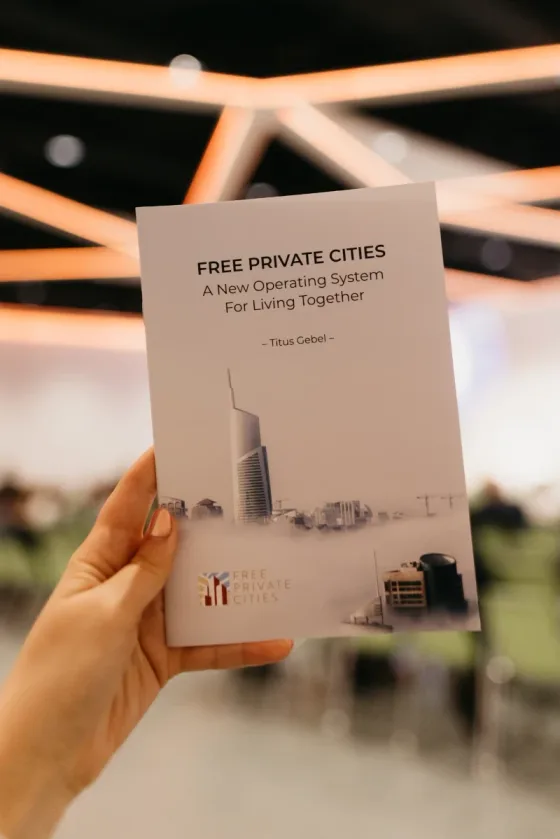
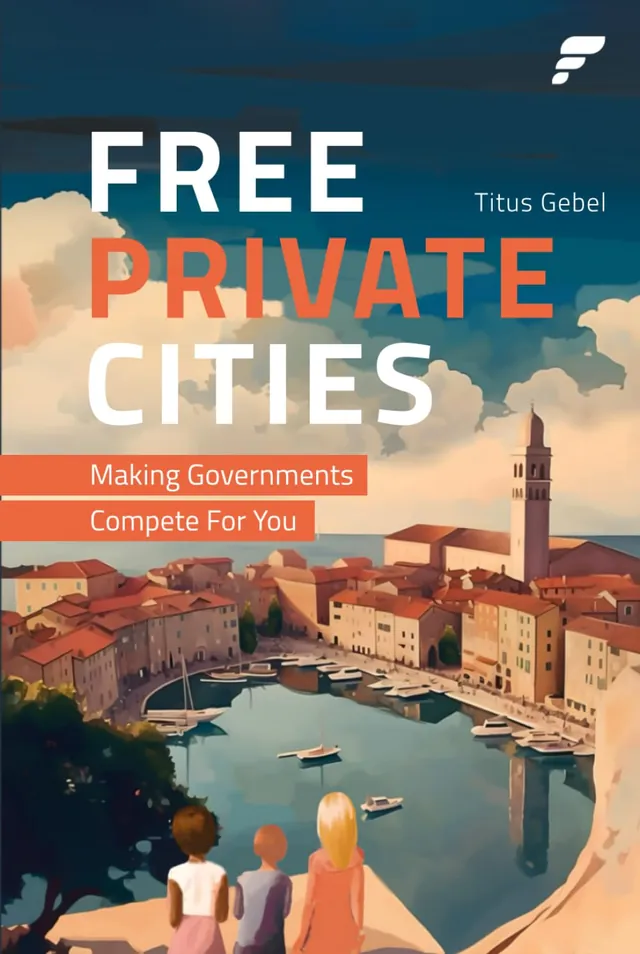
Titus Gebel’s book presents the theoretical framework for creating Free Cities, drawing lessons from past and present autonomous cities and outlining a model for building a Free City in the real world. Free Private Cities represent one of the few non-totalitarian alternatives to the majoritarian political systems adopted by most Western nation-states.
In a Free Private City, a private company acts as a government service provider, offering protection of life, liberty and property in a defined territory. The operator provides security, a legal and regulatory framework and independent dispute resolution, and residents pay a contractually fixed fee for these services. Nobody lives there without having agreed to the arrangement first.
The book moves from the foundational questions of social organization to the concept itself, its historical precursors, and the practicalities of implementation: law, citizen contracts, infrastructure, security, economics and currency. First published in 2018, the current third, revised edition adds new chapters on Charter Cities, Network States and seasteading, along with case studies such as Próspera in Honduras. The book is also available in German, Spanish, Portuguese and French.
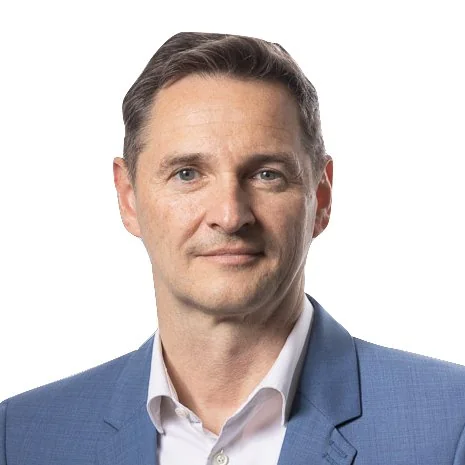
Titus Gebel
Chairman of the Board
Dr. Titus Gebel is the inventor of the Free Private Cities concept and CEO of Tipolis. He is a serial entrepreneur with a doctorate in law who has founded a number of companies, including the multinational energy and resources group Deutsche Rohstoff AG. In 2014, Titus stepped down as CEO of Deutsche Rohstoff to devote himself entirely to his new project: Free Private Cities.
Titus wants to create an entirely new product in the “market of living together” which aims to fast-track economic and societal progress. At Tipolis, a Singapore-based company, he is focused on creating and developing autonomous cities by partnering commercially with governments and special economic zones around the world. In February 2025 Tipolis signed an agreement with the Brunei Economic Development Board to explore an investment initiative there.
The concept has a book behind it. Free Private Cities: Making Governments Compete for You, published in 2018 and now in a third revised edition, sets the proposition out in full: a private operator supplies law, security and infrastructure, residents pay a fixed contractual fee instead of taxes, disputes go to independent arbitration, and the terms cannot be altered against a resident without their agreement. It is the founding text of the movement in the German-speaking world and has been translated widely since.
He came to it late and from business. He practised law briefly, moved through biotechnology and venture capital, and in 2006 co-founded Deutsche Rohstoff AG with a partner, building it into a Frankfurt-listed mining and energy group with production in Australia and the United States before stepping away to work on cities full time. He has not left the sector behind altogether: he is chairman of Argentina Metals Corp, a copper explorer in Mendoza listed in Toronto, Frankfurt and on the OTCQB since 2026.
He founded the Free Cities Foundation as the non-profit half of the same project, on the reasoning that the idea needed a home that was not a company. In 2025 he received the Roland Baader Award. He read law at Heidelberg and holds a doctorate in international law.