
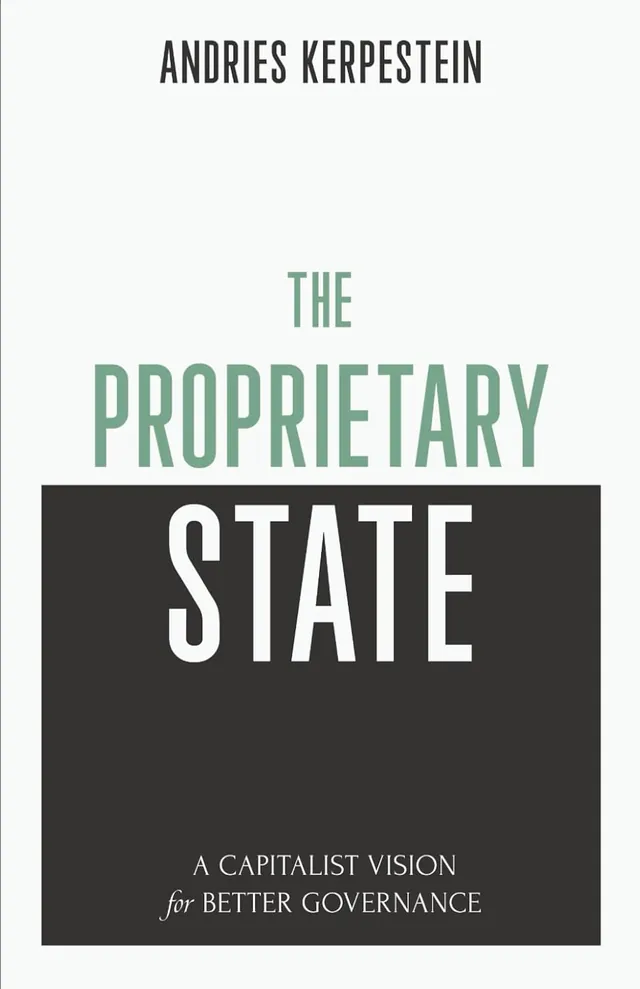
What if a government takes the form of a for-profit corporation? Andries Kerpestein explores this provocative idea, proposing a system where governments have shareholders instead of voters. Drawing on contract theory, entrepreneurship, and consumer sovereignty, he outlines how proprietary governance could outperform traditional democracies.
Kerpestein develops a theory of proprietary government and weighs the advantages and disadvantages of privatizing a government, and how to get the most out of the former while minimizing the latter. He argues that this form of governance is less novel than it sounds and could improve billions of lives.
The book carries endorsements from Erick Brimen, founder and CEO of Próspera, and from Titus Gebel, founder and CEO of Tipolis and author of Free Private Cities.

Andries Kerpestein
Author
Andries Kerpestein is an economist, entrepreneur and author who describes himself as a principled capitalist. His work is rooted in institutional economics and the case for extending market mechanisms into sectors that have historically sat outside them, governance itself among them.
In The Proprietary State, he asks what happens when a government takes the form of a for-profit corporation, a system in which it answers to shareholders instead of voters. Drawing on contract theory, entrepreneurship and consumer sovereignty, he sets out how proprietary governance could outperform traditional democracies.
Alongside the book he writes the Revolutionary Capitalism Substack, with essays on proprietary jurisdictions, network states, the future of higher education and the effect of AI on labour. His current venture is Cloud College, a for-profit higher-education model designed to lower costs while raising the quality of teaching.
The essays extend the same argument outward, including a proposal for privatising jurisdictions as a foreign development policy, on the view that poor countries are held back by their institutions rather than by a shortage of aid, and that a proprietor with capital at risk has a reason to fix them.