

Disclaimer: The following article was written by an external author. The opinions expressed in it do not necessarily reflect the opinions of the Foundation or its members.
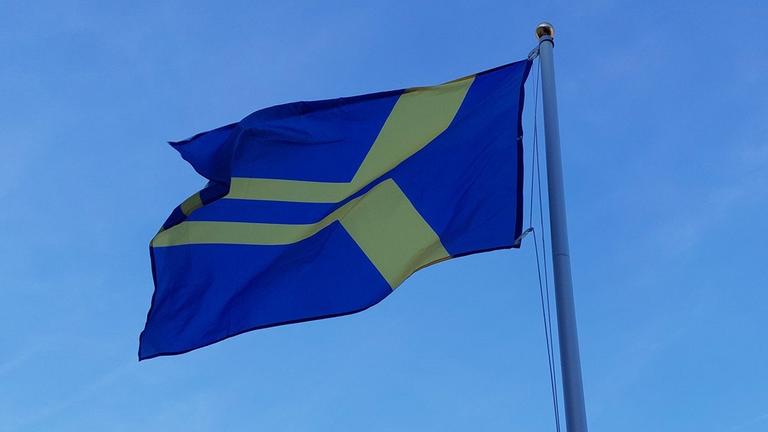
Due to the breakup of Yugoslavia in the early 1990s and the following Serbo-Croation border dispute, there are four enclaves between Serbia and Croatia that neither belong to one or the other state. The most famous of these enclaves is Gornja Siga, which was claimed by Liberland in 2015 and has had an almost permanent presence of Liberland settlers since August 2023. The former Yugoslavian territory of Pocket 1 is located 5 kilometers north of Liberland and in July 2021, this pocket was claimed by Duckionary, an Austrian-based network state, and named Panagua.
Duckionary is run by an Austrian non-profit association. It was established in 2018 by Arthur Constantin de Tourneau. The team consists of De Tourneau, who is the head of the project, and Jan-Olav Spiekermann, who serves as an advisor and security manager. Mr. Spiekermann is a trained security expert and has long been involved in the global Seasteading / Micronations / Free Cities / New Nations movement. He also has extensive experience in local politics.
Since Duckionary’s founding in 2021, the team has built an active network state with an international community coming together during both online and real-life events. The network includes representatives in Austria, Germany, Portugal, and Mexico. Duckionary is well-connected in the global Micronational Community. In 2022, together with a Greek-German network state, Duckionary launched the Micro Euro Summit as a yearly conference for European micronations, network states, and new nation projects.
The vision for Panagua is to become a small autonomous city-state, with a population of around 800, due to its limited territory. Its location on the Danube River lends itself to a port and an international business center in addition to residential and recreational areas. Panagua aims to be well connected to the surrounding Croatian and Serbian regions and contribute to their development.
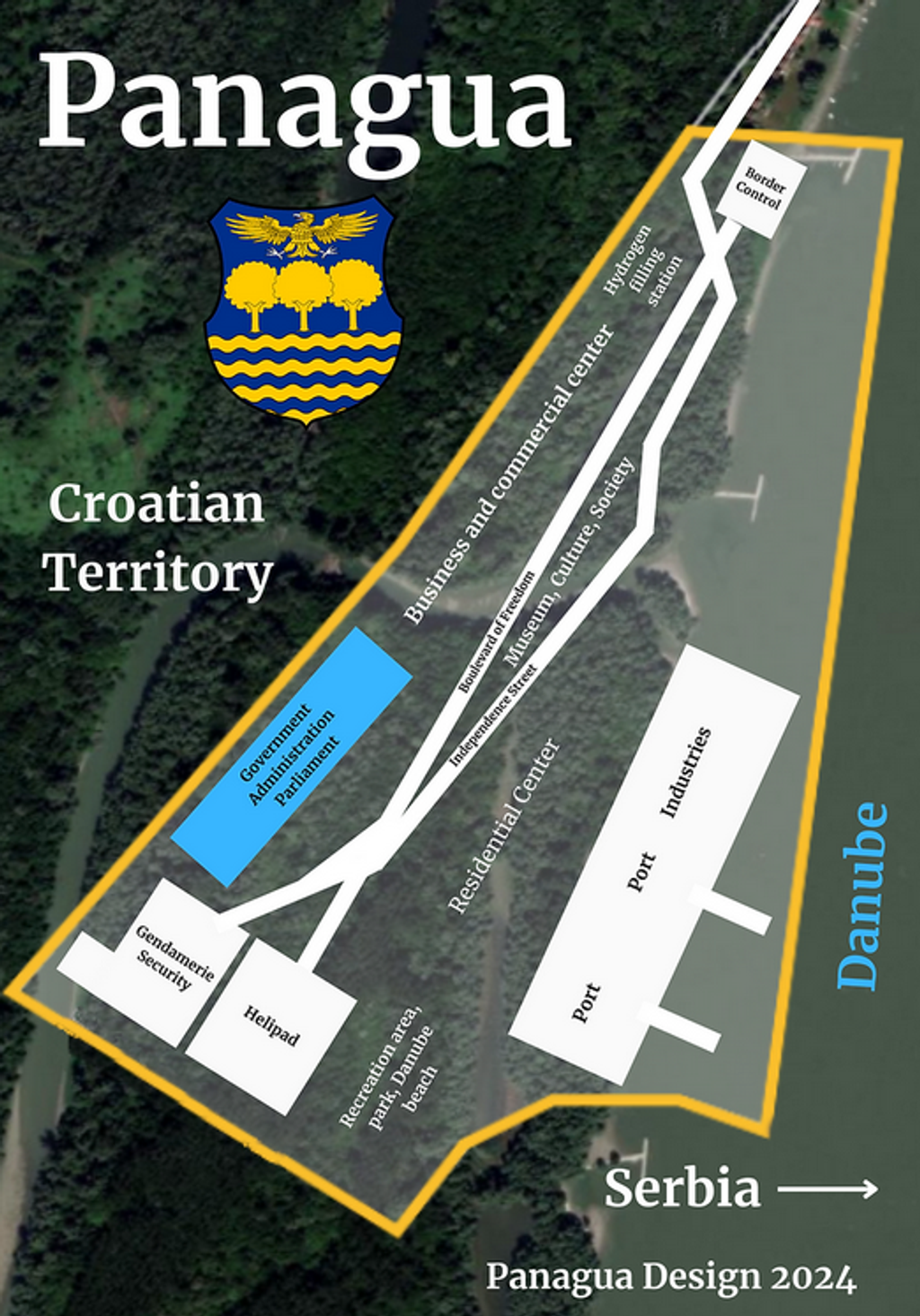
Although neither Croatia nor Serbia owns Pocket 1, the Republic of Croatia de facto controls the territory. The example of nearby Liberland has shown that without the cooperation of Croatia, any development is near impossible, as Croatian authorities will not let any serious activity or construction happen without their approval. As the saying goes, “Being right and having a right are two different things.” While Panagua recognizes Liberland’s claim to the territory of Gornja Siga, the approach of just asserting those rights has had limited success.
Therefore, our approach will be to offer Croatia a deal to establish a de facto Special Economic Zone. We will show that Panagua is not a threat or liability for Croatia, but rather a great opportunity. Special Economic Zones have been shown and proven to be among the best tools to boost a country’s development, and the most successful SEZs are those with a large amount of autonomy, where “the lights don’t go out at 5 pm.” We will also liaise with the Serbian side, especially with local representatives in the Vojvodina region, to establish friendly relations with both our neighbors.
At the moment, it is not clear if Panagua can be reached or entered without excessive interference from the Croatian authorities. To move ahead on this front, we are planning the first physical visit to Pocket 1 / Panagua in August 2025. We are also in talks with members of our community who would be open to becoming first settlers in 2025.
The project is currently operated 100% on a volunteering basis. Therefore, any donations are very much welcome to help us move forward. The example of Liberland proves that charitable contributions can have a significant impact on the development of a project of this kind. If and once we succeed in striking a deal with the Croatian government, we plan to establish a way to invest in the project. Before such a deal is secured, any physical development on the site would be at risk of destruction by the police or Croatia’s state forestry service — as proved by last year’s events in Liberland — significantly increasing the uncertainty associated with any investments.
The far-north-eastern region of Croatia, where Panagua is located, is in serious need of development. Unlike Croatia’s larger cities or the Adriatic coast popular with Central European tourists, there is little economic activity or growth in a rural region like the Danube border areas. Panagua can contribute to the region’s development in a meaningful way, just like SEZs around the world have brought jobs, talent, and growth not just to themselves but to their surrounding regions too. Panagua, as well as Liberland, are unique chances for Croatia to try out a method for economic development that has been well-proven in other parts of the world.
Historically, the region has been plagued by many animosities stemming from aggressive nationalism, state communism, and other destructive ideologies, with each taking its toll on the local population and distrust toward foreigners as well as change in general, even change in a positive direction. With the Free City of Panagua, we plan to create a beacon of liberty, good governance, tolerance, and sustainable economic growth that will have a positive impact on the development of the Slavonia and Vojvodina regions, contributing to their international and inter-cultural relations in a positive and productive way. Panagua will hopefully also be an inspiration for the development of more Free Cities in former Yugoslavia, the Balkans, and Europe in general. 2025 will be a year of great challenges and great advances for Panagua.
We invite you to join the project. Citizenship is free. New citizens, volunteers, and donors are very much welcome.