

“The institutional architecture of human settlements is more consequential than ordinary political discourse acknowledges.”
—Alexander D. Voss, A Country That Builds
Alexander D. Voss’s new book makes a claim that sounds like a provocation: the most valuable underused asset the United States owns is a naval station in southeastern Cuba, which it could turn into one of the century’s most consequential cities. On a careful reading, the provocation holds. The case is not utopian. It is, if anything, unusually concrete, and the strongest objection to it, that America no longer does things like this, is precisely the objection the project is designed to answer.
The site that has no equal
Voss’s organizing insight is that successful cities are products of design, and design depends above all on jurisdiction. He distills five elements every successful zone has shared: a territory under different rules from its surround; low taxes, light regulation, open trade, and reliable law; sustained political commitment; an inflow of talent; and anchor tenants committed early. Hong Kong, Singapore, Dubai, Subic Bay, and Shenzhen assembled these from worse starting points than the United States already holds.
That is the surprise. Guantánamo Bay, NSGB in the book’s shorthand, is federal territory with no competing jurisdiction. Acting there, the federal government works in a single layer, not the half-dozen complicating comparable mainland action. This immensely valuable precondition already exists here, alongside American property rights, deep capital markets, and well-maintained infrastructure. It inherits the world’s most reliable commercial-legal surround and sheds only the overlay that turns a five-month task into a five-year one.
Built for scale, not for show
Voss argues that Guantánamo’s scale and urgency demand a tiered structure: a master private operator runs the plan and recruits anchor tenants, while substantial sub-developers compete district by district for tenants and residents. This departs from the traditional Free City template, in which a city grows organically under one hands-off operator. This is a deliberate departure, because nothing else delivers both scale and speed. The variety it produces “is the feature, not the bug,” with precedent from Dubai’s free zones to Disney’s Reedy Creek.
A city, though, is not its balance sheet. The book’s best passages imagine a visitor ten years in, noticing the religious life, the schools, a minor-league team, a marathon through the residential districts. In short, a place with life, not merely economics. That Voss spends pages on synagogues and cycling clubs rather than tax tables is the surest sign he understands what he is proposing.
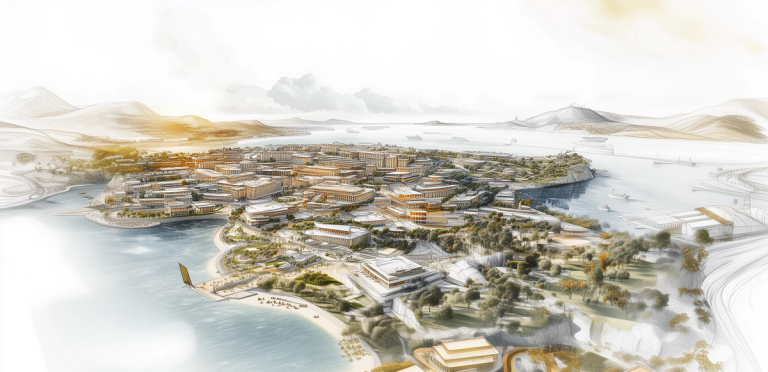
A visual inspiration for a Free City at Guantánamo Bay, from the cover of Voss’ book ‘A Country That Builds’
The part that needs no permission
The claim that a project this large needs years of legislation is wrong about the first phase. Phase 1, a Strategic Resilience Zone tied to the naval mission, a Free City Authority within the Department of the Navy, and a contracted private operator, needs only existing executive authority, no new legislation. The same authority that justified the on-base McDonald’s can authorize the first anchor tenants; legislation follows in Phase 2, once early progress has made the coalition durable. For an administration needing to show the country can still build, attract, and lead at scale, no better candidate exists — fast, cheap, and within executive reach.
The cost of doing nothing
This is a large undertaking with real risks. But the comparison is not a riskless status quo: the base already costs half a billion dollars a year for almost nothing, on a coastline held for a century and a quarter that produces nothing. “The most expensive thing about Guantánamo Bay, by a wide margin, is the opportunity cost of leaving it the way it is.” Against that, the risks are modest, the missed opportunity enormous. That is the book’s most fundamental point:
“The argument for proceeding is, in the end, an argument about the country the United States chooses to be. A country that builds, attracts, grows, takes hard projects on, is a different country from one that maintains, defends, stays in place.”
A country that built the Hoover Dam, the Panama Canal, and the interstate system once believed an empty coast was a question with an answer. A Country That Builds is a wager that it still does. The wager is worth making.
'A Country That Builds' by Alexander D. Voss was published in June 2026 by the Free Cities Foundation. You can find it on our publications page.