
SeasteadOperational
Seasteading company
ArkPad
PhilippinesAsia
About the project
ArkPad is a naval architecture company in the Philippines that designs and builds floating platforms, aquaculture systems and vessels. Its floating home, its fish cage and its glamping unit are all in use at the Reef Resort off Samal Island, the first site it has built and runs.
What ArkPad is
ArkPad is a company of naval architects, civil engineers and mechanical engineers based in the Philippines that designs and builds floating platforms, aquaculture systems and vessels, and takes on design work for other people’s projects alongside its own. It is a business member of The Seasteading Institute, and its stated goal is a floating city in open water. What it has built so far floats in Philippine coastal waters: its own floating home, the ArkPad-D, its fish cage, the Hexafarm, and its glamping unit, all in use at the Reef Resort off Samal Island, the first site it built and runs.
Where ArkPad builds
The company designs and builds in the Philippines, chosen for the workers available there, its freeports and its tourism. Its prototype was launched at Nabas on the coast of Aklan, its first working site is the Reef Resort in the Davao Gulf off the southern tip of Samal Island, and the next is drawn for the Caribbean, beside Próspera on the island of Roatán in Honduras.
How ArkPad’s platforms work
The ArkPad-D
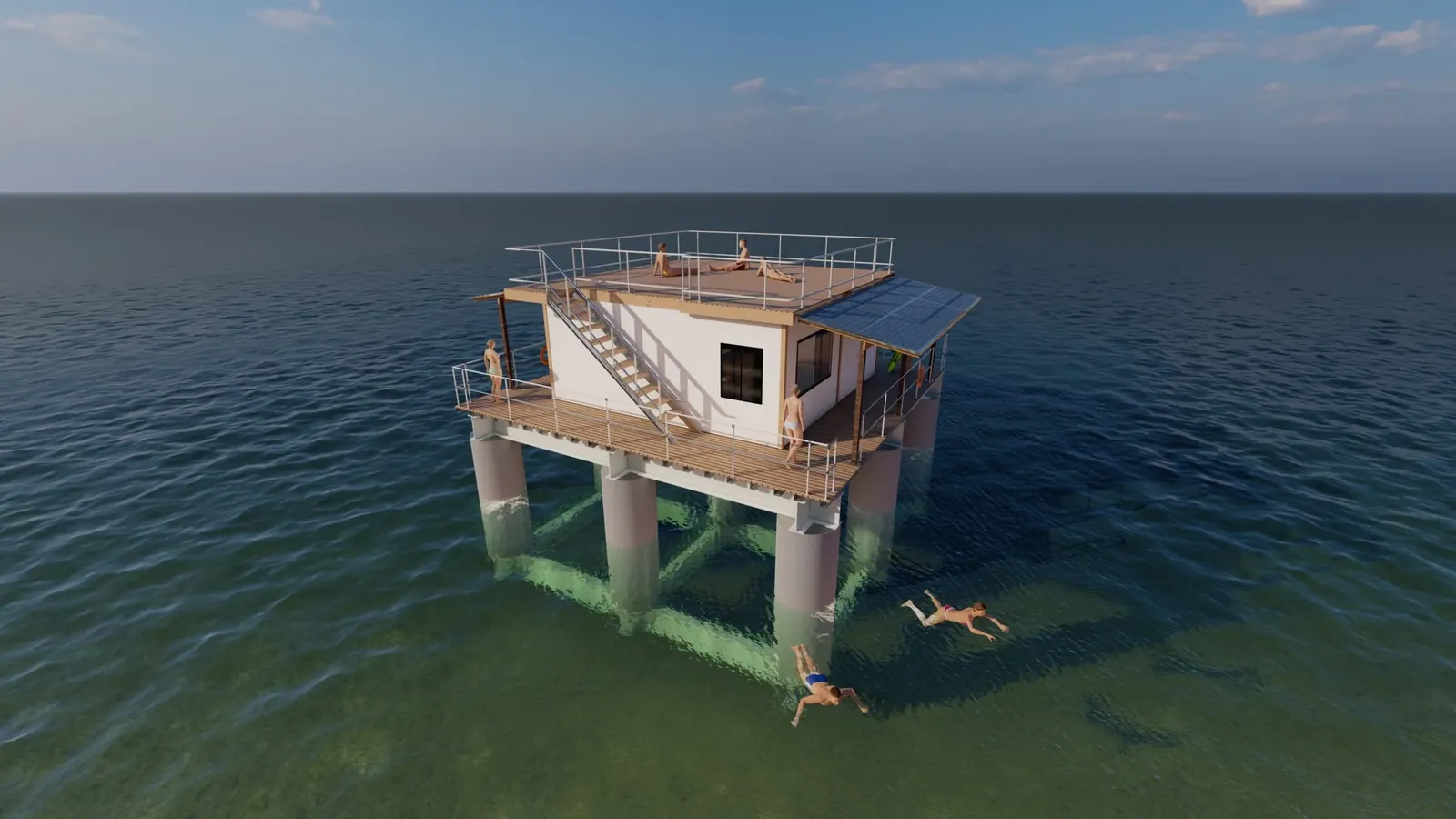
The floating home is the ArkPad-D, a platform of 490 square feet standing on spars. Its centre of mass is set below the waterline, which the company says means that even in the strongest storms it will never flip over, and it puts the largest wave the design has survived in simulation at seven metres. It is built in fibreglass and stainless steel that cannot rust or corrode, with a stated life expectancy of eighty to ninety-five years, carries a structure of up to eight metric tonnes, and needs ten metres of water beneath it. It is meant to be used with solar panels and water desalinators, and to connect physically to the ArkPads moored beside it, sharing water, electricity and internet with them. The prototype was launched at Nabas in September 2024 and came through four named typhoons that year, storms that overturned cars and wrecked homes on shore.
The Hexafarm
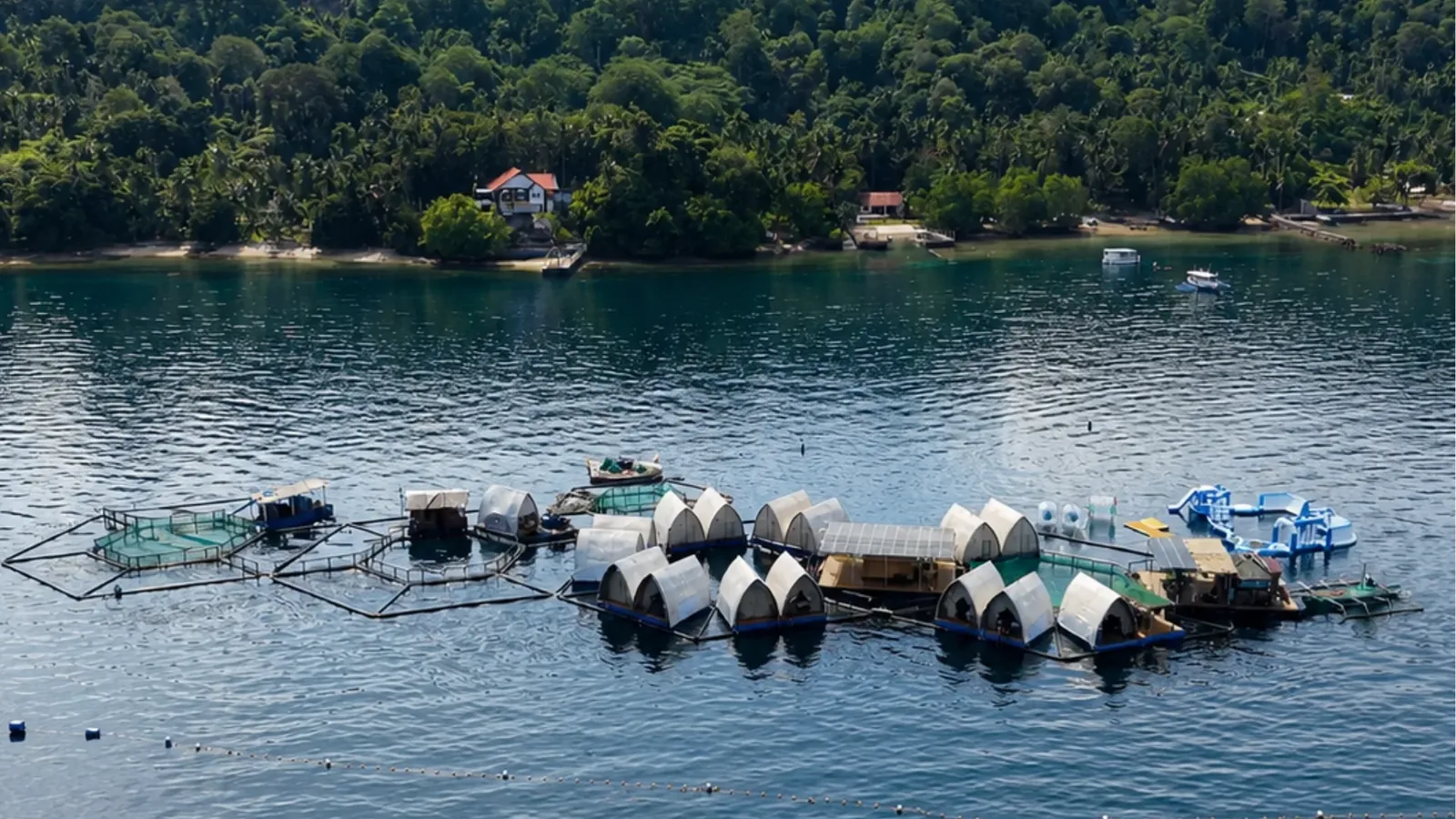
Around the homes sits the Hexafarm, a hexagonal floating fish cage built for polyculture: milkfish in the inner cage, and rabbitfish, seaweed or shellfish in the outer one, with baskets of shellfish hung inside the outer mesh and lobsters on the netted floor below. The shellfish filter the water, the seaweed raises the oxygen in it, and the rabbitfish and lobsters graze the fouling off the nets, which is labour nobody then has to spend. A walkway runs the whole way around so that guests and operators can cross from cage to cage without a boat, and one Hexafarm is built to carry up to twelve glamphouses.
Mitchell’s vision is my dream come true, plus a lot more. Joe Quirk, President of The Seasteading Institute
Where ArkPad is going
Fish farm and hotel are the two businesses meant to carry a seastead’s running costs, and the first place ArkPad put them together is the Reef Resort in the Davao Gulf, profiled on its own page. A second is drawn for the Caribbean, off the coast of Próspera on Roatán: hexagonal clusters of glamphouses with ArkPad units moored separately from them. The company calls it a goal and has published no construction date for it.
The longer ambition is a floating city in open water south of the Philippines, near the equator, assembled from the same platforms and pens. Its governance idea is jurisdictional arbitrage: each part of the settlement would take its laws from the country whose flag it flies. ArkPad names Panama as a flag already approved and the Philippines as one it expects to add after launch. Alongside the platforms the company builds ships, among them LiberArx, a solar catamaran, and works with the Institute’s volunteers on the legal recognition of seasteads.
How ArkPad came about
Mitchell Suchner came across seasteading in January 2021, began posting his own designs in the seasteading forums, and through them joined the floating-platform venture Arktide, where he became chief operating officer. He then split ArkPad off as a company of its own in 2022 and set up in the Philippines. The prototype went into the water in 2024, the resort opened in 2025, and that autumn the company received the Innovation Award at the Free Cities Conference in Prague for the first operational seasteading resort.
Locations
ArkPad puts its structures where its business is. The first working site is the Reef Resort off Samal Island; the next is intended beside Próspera on Roatán.
Articles
Blog5 min read
Venzuela, Speaker Announcements & Seasteading Opportunities
This month, we cover the dramatic political developments in Venezuela and their implications for Free Cities, announce new speakers for our conference in Próspera, and bring you up to speed on two major seasteading initiatives: LiberArx and ArkPad.
 Natalie Danelishen
Videos
Free Cities Conference 2026
Free Cities Conference 2025
Free Cities Online Summit 2025
Liberty in Our Lifetime 2024
Liberty in Our Lifetime 2024


Podcast episodes

Podcast Episode 169
Mitchell Suchner: The First Operational Seasteading Resort
Mitchell Suchner of ArkPad on the first operational seasteading resort and the economic stack that turns floating projects into ocean communities.


Worth a watch
Videos and articles from around the web, made by others rather than the Free Cities Foundation. Each one plays here, and the pill on it opens the original.
Xzar Lim
Most Unique Floating Airbnb Resort in the Philippines
A travel vlogger’s stay at the Reef Resort: the guest’s view of the glamphouses, the fish pens and a night on the water.
The Seasteading Institute
Experience Seasteading: Mitchell Suchner invites you to stay on the Reef Resort
Suchner walks the resort and explains how a working fish farm and a hotel add up to a seastead that pays for itself.
The Seasteading Institute
Seasteading in The Philippines on the ArkPad
The Institute’s own look at the ArkPad afloat in Philippine waters and the team building it.
ArkPad
ArkPad-C: Built to Withstand the Storm
ArkPad’s account of how the prototype is built to ride out typhoons, after it came through its first storm season off Aklan.
Questions
What is ArkPad?
ArkPad designs and builds floating platforms, aquaculture systems and vessels in the Philippines. Its own products are the ArkPad-D floating home, the Hexafarm fish cage and the Glamphouse, and all three are in use at the Reef Resort off Samal Island.
What is the ArkPad-D?
ArkPad’s floating home: a platform of 490 square feet on spars, built in fibreglass and stainless steel, with a stated life expectancy of eighty to ninety-five years. Its centre of mass sits below the waterline so that it cannot flip over, it is rated for seven-metre waves in simulation, and it can be joined to the units beside it to share water, power and internet.
What is the Hexafarm?
ArkPad’s hexagonal floating fish cage. Milkfish grow in the inner cage while rabbitfish, seaweed or shellfish occupy the outer one and lobsters live on the netted floor, so that the species keep the water and the nets clean between them. A walkway rings the whole cage, and it is built to carry up to twelve glamphouses.
Where is ArkPad building next?
Off the coast of Próspera on the island of Roatán, Honduras, where it has drawn a second Reef Resort of glamphouse clusters with ArkPad units moored separately. No construction date has been published. Its longer ambition is a floating city in open water south of the Philippines.
How does ArkPad relate to seasteading and Free Cities?
ArkPad is a business member of The Seasteading Institute, whose volunteers work with the company on the legal recognition of seasteads. Its founder, Mitchell Suchner, has spoken at Free Cities Foundation conferences since 2024 and received the Free Cities Conference Innovation Award in 2025.
Is ArkPad a seastead in international waters?
No. What ArkPad has built floats in Philippine coastal waters. The floating city it describes would sit in open water and take its laws from the country whose flag it flies; Panama is named as a flag already approved, the Philippines as one to add after launch.