


Cozy neighbourhoods shaded by eucalyptus trees and protected wildlands stretching from the Santa Ana Mountains to the Pacific Ocean—welcome to Irvine, a master-planned city in Orange County, California. With its Mediterranean climate, thriving economy, and more than one-third of its land reserved for green open space, Irvine consistently ranks among the happiest (top 3), healthiest (top 10), safest (top 3), and greenest (top 10) cities in the United States.
Unusually for a city of its size and stature, Irvine was built privately.
The story begins with James Irvine, an 18-year-old Irish immigrant who fled the Potato Famine and headed west during the California Gold Rush. By the late 19th century, he had acquired a 110,000-acre ranch that would remain in the family’s hands for generations. Initially devoted to agriculture—particularly oranges, which gave the county its name—the land flourished for decades. But after World War II, as California’s population surged, the Irvine Company pivoted toward urban development, laying the ground for what would become the largest private city in the US.
Designed as a constellation of walkable villages, each with its own character, Irvine was initially governed by private community associations that managed everything from trash collection to security. In 1971, the city formally incorporated as a municipality—but by then, its core identity had already been shaped. Today, with a population of over 300,000, Irvine remains closely tied to its original builder, as the Irvine Company continues to be the city’s largest landowner, employer, and taxpayer. It controls roughly one-fifth of Orange County and invests heavily in maintaining the city’s appeal.

In the early 2000s, the company donated 44,000 acres for public use, creating one of the largest networks of urban open space in the US. Giving up such a vast expanse of developable land might seem commercially irrational—but in this case, it isn’t. The city bears the company’s name, and its image is inseparable from the Irvine brand. The investment has paid off: over the past decade, new-home prices in Irvine have risen nearly 40% more than the county average. The greener the city, the higher the real estate premium.
And before you argue that only the rich can afford to pay this premium, take a look at Lavasa. A colourful oasis of cobbled streets and terraced homes nestled in pristine green slopes, it is arguably India’s greenest city—a country not known for tranquil urbanism. Its residents are mostly former farmers who, thanks to Lavasa Corporation—the city’s private developer—gained access to clean water, primary healthcare, and waste collection, much of it provided for free. When the project was abruptly halted—ironically, on environmental grounds—the community rallied in its defence. Lavasa, they said, had not only planted 600,000 trees—it had planted hope. Their campaign helped bring it back to life.

Green by Demand, Not by Decree
Sustainability doesn’t begin with paperwork. It begins with the freedom to experiment, prototype, and test. Architects crave that freedom—but it’s the client who makes it possible. When demand for greener, cleaner cities comes from the market, developers embrace it—because it adds value. But when sustainability is imposed through rigid, top-down directives, it often has the opposite effect: it erodes commercial viability and deepens the housing shortage. The result is predictable.
In the UK, for example, the City of London now mandates green roofs for all new buildings of a certain size, ignoring affordability or context—and exacerbating the housing crisis. The European Green Deal takes this logic even further: its sprawling, one-size-fits-all directives on building efficiency and carbon neutrality have left local councils from Amsterdam to Zagreb tied up in bureaucracy, unsure how to move forward. Instead of enabling green innovation, these mandates are stalling it.
Developers don’t plant trees and install solar panels out of altruism. They do it because green design boosts returns. A lush park view adds thousands to a home’s price tag. A LEED certificate—essentially, the Oscar of green architecture—opens doors to international tenants. A smart city label attracts top-tier talent. In private cities, sustainability isn’t a moral duty—it’s a business strategy.
Songdo: A Private City That Outgreened the Public Ones
If a LEED plaque is like an Oscar statue, then Songdo in South Korea is something akin to Titanic. Built from scratch on reclaimed land, this smart city with a special economic zone (SEZ) status became the world’s first fully LEED-certified community. Forty percent of its area is green space—25km of bike lanes, Venice-style canals, and urban farms nestled between high-rises.

And all of this was created privately by a group of investors led by American developer Stanley Gale, who personally contributed $100 million towards “the smartest, greenest city on the planet.” And there is hardly another place in the world where smart, energy-saving tools are integrated so deeply into everyday life. Songdo residents use mobile phones to control their homes remotely, while sensors monitor everything outside—from traffic flows to energy use. Garbage is vacuumed directly from homes to an underground waste facility.
Masdar: A City-Size Lab for Low-Carbon Urbanism
Stanford University has established a “smart city” lab in Songdo—a reminder that private cities can have a positive spillover effect when they act as testbeds for clean technologies. The city of Masdar in the UAE has taken this even further: it’s not just hosting a green lab, it is itself one city-sized green lab. Over 900 companies—from giants like Siemens and Mitsubishi to startups—use it as a sandbox. Initially led by the Abu Dhabi sovereign wealth fund, Masdar eventually handed the city’s operations to private firms.
While it never evolved into a truly living, breathing city, Masdar has succeeded as a showroom for sustainable innovation and set the trend—but also the high bar—for eco-friendly design in the Gulf. About one-third of its power needs are covered by a massive solar plant. Buildings use low-carbon cement and 90% recycled aluminium. Narrow shaded streets cool the air by 10°C. A towering wind-catcher, inspired by traditional Arabic architecture, channels breezes into courtyards. The eco-bus developed in Masdar is now part of Abu Dhabi’s public transit system. Innovations originating there have been adopted as far afield as Seville, with its energy-generating towers, and the UK’s London Array offshore wind farm.
Crucially, all of this was made possible not despite its commercial turn but because of it. As control shifted from public planners to private tenants, Masdar gained the agility and investment needed to scale real-world experimentation.
Zones of Progress: The Past, Present and Future of Special Economic Zones, a documentary produced by the Free Cities Foundation, takes a look inside Masdar and interviews its Director.
Private Planning Thinks in Decades, Not Election Cycles
Private planning is often accused of short-termism. In reality, it promotes long-term value creation. Developers invest in nature trails, preserve habitats, and favour local materials not because of ideology—but because it pays. If the owner benefits from the land’s future appreciation—as the Irvine Company did—it has every reason to plan for durability, livability, and environmental quality. In this context, sustainability is not a regulatory burden but a competitive advantage.
Crucially, the landholding must be large enough for the developer to internalise externalities—another reason why entire private cities, not just isolated developments, make sense. Just as important is the security of property rights. If governments want to foster green innovation, they don’t need another roadmap or directive—they need to ensure that the rules of the game are clear and predictable. Without rule of law, none of this works.
Charter Cities as Green Testbeds—If They’re Allowed to Work
Take Próspera and Morazán, the famous free cities in Honduras. The ruling party’s arbitrary attacks on them not only put thousands of Hondurans at risk of losing jobs and homes and send a chilling signal to investors—they also slow down innovation. Próspera’s residences—curvaceous, timber-crafted, digitally customisable homes designed by Zaha Hadid Architects—are advancing architecture well beyond the Caribbean. Do Honduran politicians realise that, by undermining charter cities for short-term political gain, they are holding back global progress?
As Shajay Bhooshan, head of Zaha Hadid Architects’ computation and design team, put it:
“Things like 3D printing, timber construction, and all these emerging technologies—are evolving rapidly. You see many companies investing large amounts of money to build factories, but then they run into regulatory barriers.”
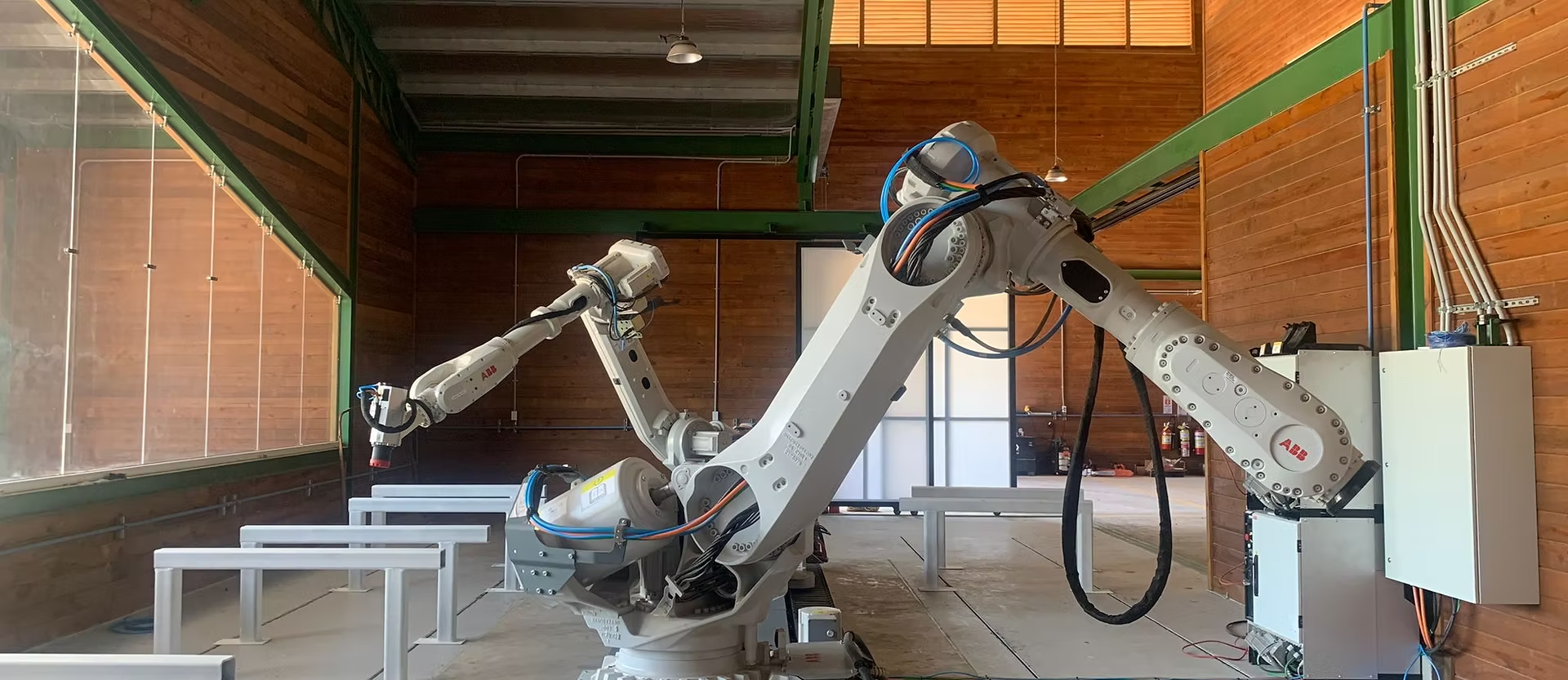
The Circular Factory in Próspera enables on-site production of digitally customised timber housing using robotic arms and 3D printing tools. Source: Circular Factory
Let Cities Compete—The Planet Will Win
Private cities are not just good for residents. They’re good for the planet. Cross-country studies show that CO₂ emissions per capita tend to fall once a country’s GDP per capita reaches around $10,000–15,000. In other words, economic growth is a prerequisite for ecological improvement. And cities with SEZ status—like Shenzhen, which transformed from a fishing village into a megacity of over 17 million within a single generation—are among the most powerful tools for lifting people out of poverty.
Chinese data makes the point clearly: as the size of SEZs increases, urban CO₂ emissions per square metre fall. This is because SEZs foster vertical spillovers of green technologies into the wider city. Moreover, firms operating within Chinese SEZs filed 17% more green patents, showing that these zones actively stimulate green innovation. With prosperity comes cleaner air.
In conventional cities, red tape often trumps green dreams. But private cities have more room—and incentive—to experiment. If we are serious about solving global challenges, we must move beyond ideological reflexes. Many private cities are already leading the way—offering testbeds for green design, fostering economic growth, and demonstrating that sustainability can align with market incentives. From timber construction to smart grids, they are already testing what the rest of the world is still debating. Because in the end, green dreams don’t need subsidies. They just need permission.