
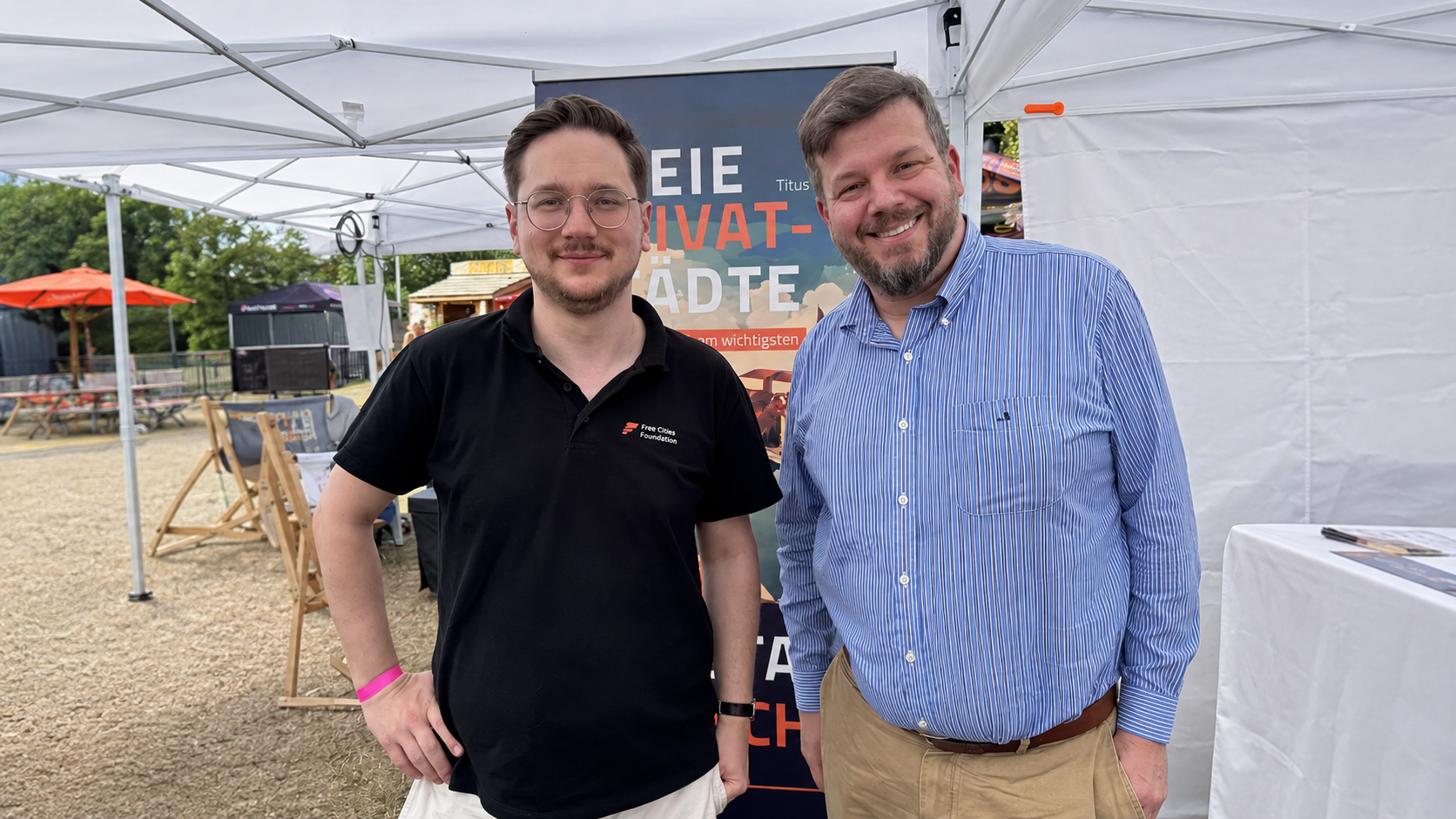

Can you fight the state by becoming the state? It is the one question every political libertarian has to answer, and Johannes Kaiser has heard it more often than most. Last November, the leader of Chile’s National Libertarian Party won 14 percent of the vote in the country’s presidential election, one of the strongest results a libertarian party has ever achieved anywhere in a national first round. A few months later, we found ourselves sitting across from him at a lakeside campground in eastern Germany, asking him exactly that question.
His answer was blunt: “It’s like you’re going to go to Adams or Jefferson and say, you know what, if you make a revolution against the king, you’re the king. Come on. That’s stupid.”
In this interview, Kaiser explains why libertarianism is winning elections in Latin America while it stagnates elsewhere, why he believes the moral argument beats the economic one, and, for the first time in detail, how he would respond as a head of state if someone proposed building a Free City in Chile. Watch the full conversation below, or read on for the background, the highlights, and the complete transcript.
Who Is Johannes Kaiser?
Johannes Kaiser Barents-von Hohenhagen is a Chilean congressman, the founder and leader of the National Libertarian Party (Partido Nacional Libertario), and was one of the defining figures of Chile’s 2025 presidential election. Born in Santiago in 1976 into a German-Chilean family, he built his political base not through party machines but through a YouTube channel, El Nacional-Libertario, where he spent years making the case for individual liberty, free markets, and national sovereignty to a growing online audience.
That digital following carried him into the Chilean Chamber of Deputies in 2021. In 2024 he founded the National Libertarian Party, whose growth since then has been remarkable. As Kaiser notes in our interview, it now counts more than 50,000 members, making it the second largest party in Chile by membership, and it holds eight seats in the Chamber of Deputies and one seat in the Senate.
In the presidential election of November 2025, Kaiser finished fourth in a crowded field with roughly 14 percent of the vote. For a party that was barely a year and a half old on election day, it was a breakthrough result, and it established Kaiser as the leading voice of principled libertarianism in Chilean politics.
The Kaiser Family: A Libertarian Force in Chilean Politics
Johannes Kaiser is not the only member of his family shaping Chile’s libertarian moment, the Kaisers work in something like a division of labor for the movement. His brother Axel, one of the most influential libertarian intellectuals in the Spanish-speaking world and a longtime leading figure of the Santiago-based think tank Fundación para el Progreso, spent more than a decade building the cultural and intellectual case for free markets that Johannes would later run on: the candidate could harvest what the intellectual had sown. Their sister Vanessa, elected in November 2025 as the first libertarian senator in Chile’s history, delivered the party’s Senate seat that Johannes mentions in this interview.
Behind the Scenes: A Weekend at Afuera Fest 2026
This conversation happened at Afuera Fest 2026, a three-day libertarian festival held at a lakeside campground in Gerlebogk, Saxony-Anhalt, Germany. Inspired by New Hampshire’s legendary PorcFest and named after Javier Milei’s favorite one-word verdict on wasteful ministries, Afuera Fest brings together the German-speaking liberty movement for talks, workshops, music, and long nights of debate around the campfire.
Kaiser flew in from Santiago as one of the festival’s headline guests, and we at the Free Cities Foundation spent the whole weekend with him. What does not make it into the camera frame: hours of private discussion about political strategy, the state of the West, and the question of how much freedom a single politician can actually deliver. Kaiser is exactly the same person off camera as on camera, which is rarer among politicians than you might hope. He debates for the joy of it, quotes Jefferson and Mises from memory, and answers to his principles rather than to the speech codes and expectations that usually come with political office: what he believes is what he argues, camera or no camera.
One theme kept coming back throughout the weekend, and it is worth understanding before you watch the interview, because it explains almost everything about how Kaiser does politics.
The Moral Case for Libertarianism
“If somebody comes to you and takes money from you, gives you nothing in exchange, well, it’s stealing from you.”
The logic is simple, and Kaiser credits the same insight for Milei’s success in Argentina: taxation that takes from people who work in order to feed a political class is not presented as inefficient, it is presented as wrong. “We have taken a moral stance on these issues,” he told us. “The other side doesn’t have much to oppose it with, because the moment you reduce it to the basics, it’s true.”
For Kaiser, this is not primarily a promise of better outcomes. It is a vision of a better society grounded in moral principles: a society where families educate their children in the values they see fit, where speech and faith are free, and where the state is restrained from entering the parts of life where, in his words, it has no business. He argues that libertarian parties in Latin America succeed precisely because they stopped fighting on economics alone and caught up with the left on the level of values and culture. The lesson he offers European and North American libertarians is uncomfortable but clear: people do not man the barricades for efficiency gains. They fight for what they believe is right.
Interview Highlights
Why libertarianism is winning in Latin America
Kaiser argues that Latin American libertarian parties differ from their counterparts in Europe and the United States because they fight on social and cultural questions, not only economics. In Chile, the violent unrest of 2019 was the turning point: his movement became the hardest opposition to what he calls an attack on the democratic system, online and on the streets, and converted that resistance into votes.
Is entering politics un-libertarian?
Asked whether becoming the state betrays libertarian principles, Kaiser rejects the premise entirely. There is no territory on earth without a power structure, he argues, so the only real question is what kind of power structure you will live under. Libertarians who refuse to engage are, in his view, avoiding responsibility: “You cannot get rid of it. What do you do? That’s the question we have to answer.” His goal in office would not be to do good with power but to restrain it, to take the weapon of power and, as he puts it, keep it safe from children who believe they can fix the world by force of will.
A Hong Kong on your own shores: Kaiser on Free Cities
The heart of the interview for our community: how does a potential head of state think about Free Cities? Kaiser sees the opportunity clearly, a low-regulation core that develops at a different velocity than the rest of the country and becomes a hub of wealth creation radiating outward. He points to historical precedents like Hong Kong and Macau and proposes a concrete model: not selling territory, but renting it, under a carefully negotiated legal framework that grants broad autonomy while the host state keeps defense, sovereignty, and a guaranteed minimum tax paid to the motherland.
“Where can you build a Free City, if not in a country that has a state that allows a Free City?”
He is equally clear about the limits. Permanently ceding sovereignty is politically impossible, and constitutional human rights protections such as the right to life and free speech would have to apply inside any Chilean Free City. Within those limits, though, his verdict is remarkable for a sitting congressman and presidential contender: can it be done? “I think yes.”
The next decade
Kaiser sees a fractured West, with some countries recovering their sanity and others sinking deeper into what he calls madness. But he reads the current wave of state pressure on dissenters as evidence that the freedom movement is winning the argument. His time horizon is long: “It may not be my generation that is finally successful. But we will have successes. And we’re showing success now.”
Full Interview Transcript
The following transcript has been lightly edited for readability. Jan Bertram interviews Johannes Kaiser for the Free Cities Foundation at Afuera Fest 2026 in Gerlebogk, Germany.
Jan Bertram: Hello Johannes, nice to meet you. Johannes was a presidential candidate in Chile last year. He got 14 percent in the presidential election, and he is the leader of the National Libertarian Party. Today he is joining us here in Germany at the Afuera Fest, which is a local libertarian festival. You traveled here from Chile. Johannes, what brought you here?
Johannes Kaiser: Oh, you know, it is very important to get some connections with the rest of the world. We are not fighting this fight alone. We have an adversary, an enemy, that is interconnected and works together on a global basis. So we have to do the same. And to do that, we have to plant the seeds for this kind of cooperation.
Jan Bertram: Absolutely. And it is amazing to see the kind of libertarian wave that is going through Latin America. We have Milei in Argentina, we have huge successes in Brazil, and now you just recently founded the National Libertarian Party. How long have you been actively involved in politics in Chile?
Johannes Kaiser: Actively involved around four or five years, from the point I joined the Republican Party in Chile. I was elected as a congressman and then split from the Republican Party due to ideological differences, and started to build up the National Libertarian Party one and a half years ago. And we had a very good run for being so young. We have over 50,000 members, which makes us the second biggest party in the country by number of members. We have eight congresspeople now in Parliament and one senator.
Jan Bertram: Out of how many in total, just to give our audience an idea?
Johannes Kaiser: There are 155 congressmen in Parliament and 50 in the Senate. But only half of the Senate was renewed last election. So I think we did a good job here.
Jan Bertram: That sounds like a tremendous success. Why do you think libertarian politics is finally starting to gain momentum? It is a relatively new phenomenon to see libertarian parties gaining substantial electoral results. Why is it happening now?
Johannes Kaiser: First, you have to understand that the libertarian parties in Latin America are a little different from those in Europe and the United States. We have made it part of our discourse that it is not only about economics, but also about social and value questions. That means we have finally caught up with the left, which has been working on this level all along. That is the first thing. Second, the states in Latin America: Argentina had completely failed. Brazil is stable, but not too stable, and you have a huge rise of a mixture between the religious right and the libertarian right that somehow works together up to a certain point. It is very strange to observe. And in Chile, we had the revolution of 2019, where all the masks of the left fell. The reaction was very strong, and through our digital presence we were able to channel much of the discontent with this attack on our democratic system. We were the hardest opposition to that revolution, on the internet and also on the streets. That is what we capitalized on. We mobilized a lot of people.
Jan Bertram: From your experience in political activism and campaigning, what are the messages that resonate best with your voters, or with people in general?
Johannes Kaiser: First, that libertarianism is a moral stance. You have to listen to Milei: taking from people who work to give it to people who are just in the state is an immoral thing to do. It is not good. It is stealing, and stealing is not good. We have taken a moral stance on these issues, and the other side does not have much to oppose it with, because the moment you reduce it to the basics, it is true. If somebody comes to you and takes money from you and gives you nothing in exchange, well, it is stealing from you. And lots of people are understanding that. They are also understanding how their freedoms are being eroded. The freedom to educate their children in the values they see fit. The freedom of speech, of faith. All of these freedoms have been curtailed by a left that has become more totalitarian day by day, supposedly in defense of minorities, but in effect suppressing the rights of the majority. And we are making the argument for majority government, to defend majority interests. Why? Because in every majority, minorities are also included. If you make politics for the entire Chilean people, it also benefits gay people, women, everybody. Everybody benefits if you make politics for the entire country. That is something that has been lost on the left. The idea of supporting big majorities of the population has been given up in favor of defending the little interests of small, very active, and very vocal political activist groups.
Jan Bertram: So you are claiming that if you are elected, you are going to do good for the people. But many libertarians would probably reject the premise of joining the House of Cards game and becoming a politician in the first place.
Johannes Kaiser: I am not claiming I will do good for the people. I am claiming I will restrain the state from going into those parts of society where the state has no business. The state does not have to tell you how to teach your children, or what to tell your children, or what to believe, or how to speak, or things like that. We are talking about going into power to take the weapon of power and keep it safe from children. Children, because that is what leftists are: children who think they can fix the world just with their will, and that there is always somebody who is the bad guy, and that is why the world is not perfect. That is not true. It is a childish way of seeing the world, and this child with weapons and power is very, very dangerous.
Jan Bertram: Nevertheless, many would claim that joining this game, switching sides and becoming the state, is in itself quite un-libertarian. What is your personal view on that?
Johannes Kaiser: It is not. It is like going to Adams or Jefferson and saying: you know what, if you make a revolution against the king, you are the king. Come on. That is stupid. The state is an organization that you cannot simply get rid of, because where there is no state, two days later a new one has imposed itself onto the territory. There is no such thing as a territory where human beings live that is not under some sort of power structure. So the question is: what kind of power structure will you have in your territory? And that is the point where libertarians have to take responsibility and not be childish. That means: okay, you cannot get rid of it. What do you do? That is the question we have to answer. We always have to be the force pushing against totalitarianism, always pushing for more freedom. The way is the target: advancing in that direction is the win. And if it is just two centimeters, it is better than everything we have lived through in our lives. In the last 40 years we have lost so many freedoms. The state is omnipresent, everywhere. When we can push it back just a little, we have already won something. And if you do not want to push because you are too lazy, or you think you are not good enough to do it, well, then we will keep losing. I do not like to lose.
Jan Bertram: Well, I understand. But the answer we at the Free Cities Foundation are giving to the question of the governance structure is, of course, to build more Free Cities.
Johannes Kaiser: That is great. But I will tell you: by building a Free City, you will not get rid of governments. You will do it with the allowance of some government that says: you know what, let us do it. You will be free in our territory. But you will still have to get protection and defense. And if you do not have it, well, somebody else will occupy or buy the state, especially if it is economically successful. So where can you build a Free City, if not in a country that has a state that allows a Free City?
Jan Bertram: Absolutely. And that is kind of the reason we are sitting here together. Usually at the Free Cities Foundation we speak to builders, to people who want to build a Free City, to community leaders. We speak to people who support building Free Cities by contributing their workforce or their investment capability. But we rarely have the opportunity to speak to politicians who would potentially be willing to support such a cause from the side of a host nation. So, given you were in a decision-making position and people approached you to build a Free City in your country, what would you say, hypothetically? Where do you see the opportunities? Where do you see the political risks? Share your point of view on the whole topic from the politician’s side.
Johannes Kaiser: Well, the opportunity is to have a core that develops at another velocity than the main country, with fewer regulations and probably a very, very dynamic inner life. That means a hub of wealth creation. That is the interesting thing for a country. The problem, or the question, would be: okay, which laws will apply? You have your own laws? That is logical if you want to have a Free City, at least to some degree. Then we have to come to some agreements, and that would be a very hard negotiation. For example, and I am just taking the argument to the extreme: we could not have a Free City where the law allows slave trade. No chance. Because we do not give up defense or sovereignty, we as a country would then be responsible for what is done there. So there are limits to the autonomy that can be given. Can it be done? I think yes. Maybe in a system of concessions, like in the very old German Empire, or in China during the colonization process. Think about Macau or Hong Kong. You could advance something in that direction. But I tell you what, it would be a huge legal challenge to reach that kind of decision. And the other thing: somebody has to pay for it. There is no free money.
Jan Bertram: Well, I think this is where the operator would take care of bringing in investments, which is one of the arguments governments usually respond very well to: getting more foreign direct investment. On the other hand, from working in Free Cities and talking to governments, it often seems much easier to convince the politicians than to convince the voters of the politicians. Politicians are often on board, they like our idea, but they push back and say it will be quite hard to sell to voters. So what do you think about this whole notion of states allowing Free Cities with a larger degree of autonomy within their borders? How do you sell it to the crowd?
Johannes Kaiser: I think as long as you have a kind of rent, not selling, but renting a part of the territory for this experiment, we could get people to accept it, especially if you confront them with the possibility of having a sort of Hong Kong on your own shores. You know what I mean? This hub of development would radiate into the country. I think you could do that. What is impossible is to give up sovereignty or a part of the country permanently. That is a no. I think it is absolutely impossible to convince people to do something like that. But a rent, and a finely developed legal framework that gives enough autonomy to the Free City but keeps certain central rights protected. It has to be an agreement. The way out could be, for example, a minimum tax that has to be paid to the motherland, and the rest can be decided within the autonomous zone. I think it is possible. But, for example, the right to life, free speech, things like that: I do not think we could ask for a legal reform that would allow these human rights not to be protected by the Constitution in some part of our territory.
Jan Bertram: Well, that is what some others have as their political concepts. But we at the Free Cities Foundation lean quite heavily towards having rather more than less of these rights. So I agree.
Johannes Kaiser: But do not forget, a lot of these things also have to do with the understanding of power, who takes the final decision, and whether the people will be protected or not. It is more a question of trust, and of the Free City not developing too far away from the main country on certain matters of principle. I am not speaking about administration or things like that, but about certain matters of principle. I mean, if you want to introduce Sharia law, I do not know.
Jan Bertram: Well, personally, I would say that the Free City needs to blend into the culture of the country.
Johannes Kaiser: That is what I am trying to explain to you. Less regulation, perfect. But you have to have a system for resolving disputes. And you have to work out how you handle the control of imports and exports from the Free City into the country itself.
Jan Bertram: You are clearly not on the Free City path yourself. You want to become president. So I assume we are going to see you make a free country instead. Are you going to reenter the next election race?
Johannes Kaiser: The whole of Chile has to become a Free City.
Jan Bertram: That is a little bit what Milei is also claiming for Argentina, and it is one of the reasons why he has pushed back on Free Cities. His overarching goal is, of course, the same as what you are saying: he wants to make Argentina a better place. But the question is to what degree an elected politician can change the trajectory of his country, and many politicians have not lived up to expectations. So how do you see your own engagement in politics in this regard? Why do you think you are going to make the impact that other leaders have failed to deliver?
Johannes Kaiser: I do not think, I just do. I do not go in expecting success. We just work for it. And if we can advance in some part of the legal system, or in the culture war, we have already won. Not a big win, but a win. We are not looking for a utopia. We are just fighting to get there. I would say the ones who do not advance things are those who are more interested in achieving things fast than in just doing the work. It may not be my generation that is finally successful.
Jan Bertram: Well, Thomas Jefferson said that every generation has to fight for its freedom.
Johannes Kaiser: Yes. It may not be my generation that is finally successful. But we will have successes, and we are showing success now. We stopped the most extremist left you have seen in Chile in a very long time. Very, very violent. We stopped them in their tracks. We are pushing them back. We are getting our country back. And yes, the current government is not even soft in the way we would like for our taste, but we are pushing the government in the right direction too. And we have successes to show.
Jan Bertram: And in global terms, or at least regional terms: we saw some successes in the battle for freedom, and we saw some pushback against leftist ideas. What do you envision for the next decade, not only in Chile, but in Latin America and the global West? Where do you see the trajectory? Is it going up, is it going down? What is your gut feeling, your educated guess?
Johannes Kaiser: My gut feeling is that we have different trajectories. The Western world is fractured. You have some parts of the world that are recovering, and others that are just sinking more and more into madness. I would say, if in the next ten years we can all agree again that man is a sexual description of a human being and not just an identification, we would be more or less back where we were at the time of Adam and Eve. But if we could just go back to rational thinking in society, then the rest of the road is paved for success. I think we are advancing in that direction. What we are living through now, this very strong pushback of state power against dissenters, shows that we are winning the argument. Again, they have nothing else to show than brute force to try to shut down dissenters. And if we can keep going, take this brute force away from them, put it into a basket and lock it away, we will win.
Jan Bertram: Well, first they ignore you, then they fight you, and then they say they were with you all along. We are certainly at the stage where they have started pushing back much harder than before, and I think you can see that in many Western countries.
Johannes Kaiser: Yes. The opposition, the Germans, are packing their bags and moving away. And we do not shoot them in the back as you used to do. So, well, I would be proud of that.
Jan Bertram: That is nicely said. It is interesting, though, to see that things are certainly moving in a better direction. I have witnessed this myself over the last 15 years, and so have you, probably. But we are not back at the level of the 2000s.
Johannes Kaiser: The left pushed us way over the edge. To go back to the year 2000 would be a huge success. We would be back on top. But it will be hard work, and it is very much about the people leading this journey.
Jan Bertram: It has been very interesting talking to you because, like I said, usually we do not meet many politicians who advocate for freedom so strongly.
Johannes Kaiser: Yes, most do not advocate for freedom at all.
Jan Bertram: And it is always interesting to find potential allies on all sides for our cause, because there is always some form of government. Our model is having Free Cities decentralize governance and provide opportunities by privatizing governance. But there also needs to be some form of support from traditional governments to allow Free Cities to exist.