
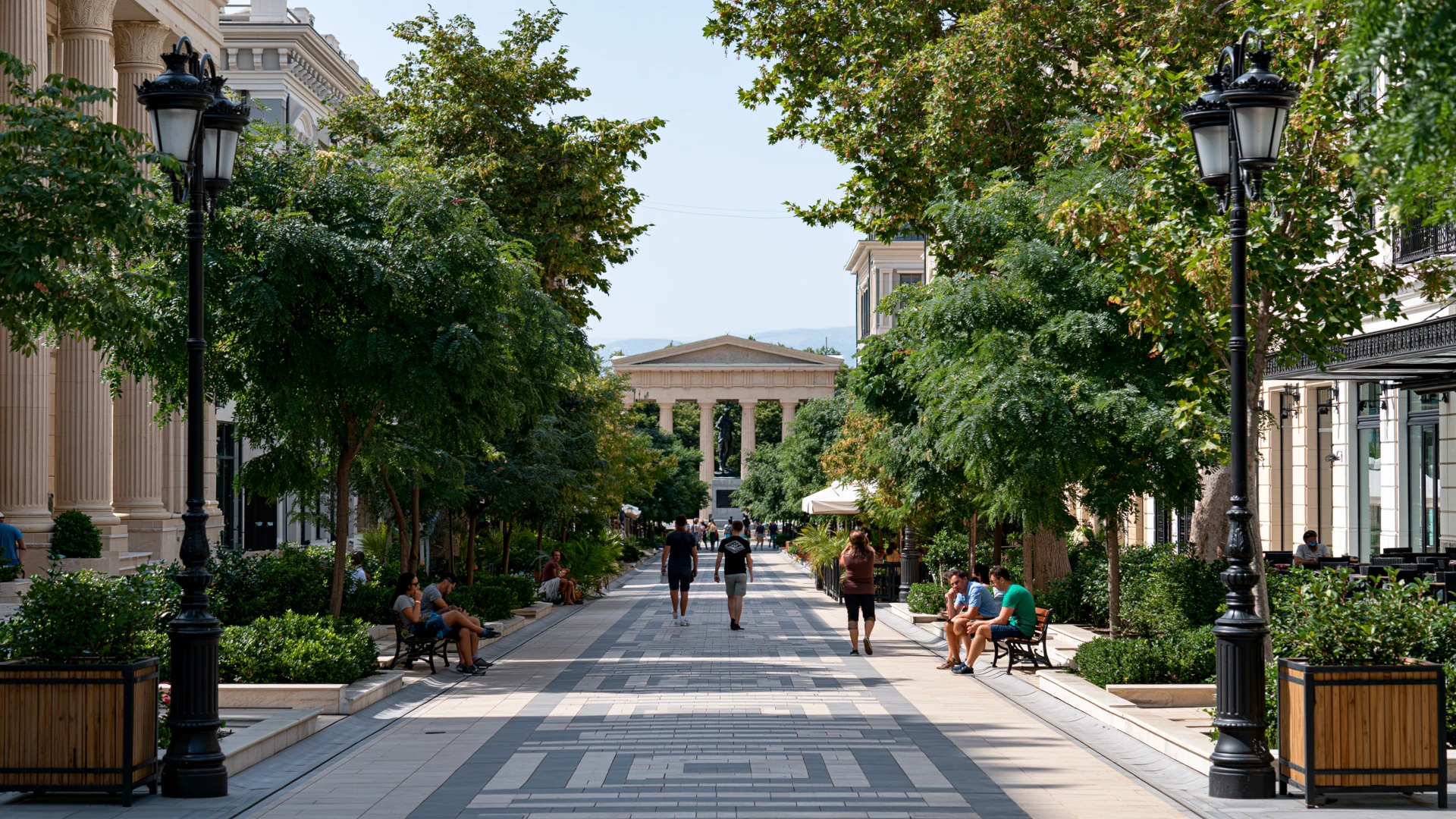

If you are building a Free City, a special economic zone, or any new jurisdiction from scratch, here is a piece of advice that sounds frivolous and is not: invest in beauty before you think you can afford to. Big public art is one of the cleanest ways to do this quickly, but the principle is broader than sculpture.
Beauty agglomerates people. That is the entire argument. Humans gather at attractive places and disperse from ugly ones, and they do this with very little conscious deliberation. A waterfront with a good view. A square with a fountain. A hill with a frame at the top of it. All of these pull foot traffic, conversation, photographs, and eventually residents. A featureless lot with a chain-link fence does the opposite, no matter what the regulatory environment around it happens to be. New cities live or die on whether they can get a critical mass of people into the same place at the same time, and beauty is one of the few tools that does this on autopilot.
Próspera, the charter city on the Honduran island of Roatán, has a picture frame at the top of a hill. Look through it and you see the water. The frame is modest in scale, but it does its job: visitors walk up, stand inside, take a photograph, and the geotag spreads. Dubai built the same idea at a different budget. The Dubai Frame is 150 meters tall, framing the historical and modern halves of the city through its opening, and it pulls in roughly a million visitors a year. Same concept, very different scale, both effective. The shared move is simple: give people a beautiful place to stand and a beautiful thing to look through.
Why beauty matters for new jurisdictions specifically.
It makes the place feel real. A regulatory charter and a website are abstractions. A well-sited sculpture, a planted boulevard, or an architecturally serious public building is a fact on the ground. Prospective residents and investors update their priors when they see infrastructure that costs real money. Anyone can print a logo. Commissioning a working architect, or fabricating and installing a five-ton steel piece, is harder. People read the difference as evidence that the project is funded and organized.
It manufactures awareness for free. Traditional cities inherit recognition; you have to make it from scratch. The cheapest production process available right now is letting visitors take pictures and post them. A city without a visual signature gets scrolled past. A city with one striking landmark in a flattering location generates thousands of geotagged posts a year, each one a small advertisement to the photographer’s followers, most of whom have never heard of the place. The cost per impression is unbeatable.
It builds the local social fabric you cannot otherwise rush. The residents you do have arrived recently and share no civic vocabulary. They need common reference points so they can act like locals on day one. A landmark provides that. People give directions by it. They meet friends at it. They walk visitors over to see it. None of that happens around a regulatory framework, no matter how well drafted. It happens around things that are pleasant to be near.
The standard objection is that Instagram-friendly art tends to be mediocre and chosen for legibility rather than depth. The criticism is fair and beside the point. You are not curating a museum; you are running a settlement campaign. The piece has to read clearly from a phone screen, photograph well in different lighting, and survive a decade of weather. A subtle gallery work will not pull anyone off a plane. A frame at the top of a hill, looking out over the sea, might.
A note on budget. The temptation is to wait until the city is “ready” before spending on something this discretionary. That is the wrong order. Beauty is not a reward for arriving; it is part of how you arrive. Roads and schools take years and barely register on social media when they finally open. A well-placed sculpture or a thoughtful park takes months and starts producing returns the day it opens. Front-load the visible pieces, then build the rest of the city around them.
Big public art is the cleanest illustration of this principle because it is the most legible. But the broader category is what matters: trees, fountains, lookout points, plazas, lighting, public buildings with real architects behind them, anything that gives a place a face. Free Cities face unusually high marketing pressure and unusually thin civic identity at the same time. Beauty is one of the few interventions that addresses both for a price that is small relative to other infrastructure costs. Próspera put a frame at the top of a hill. Dubai built one you can walk inside. The principle is the same at every scale. Make the place beautiful first. The people follow.
Alex Voss is the Chief Financial Officer at Tipolis and the Head of Bitcoin Strategy & Board Director at the Autris Group (OTC: AUTR)
Find him on X at @AlexDVoss.
Cover image created by Midjourney AI.